
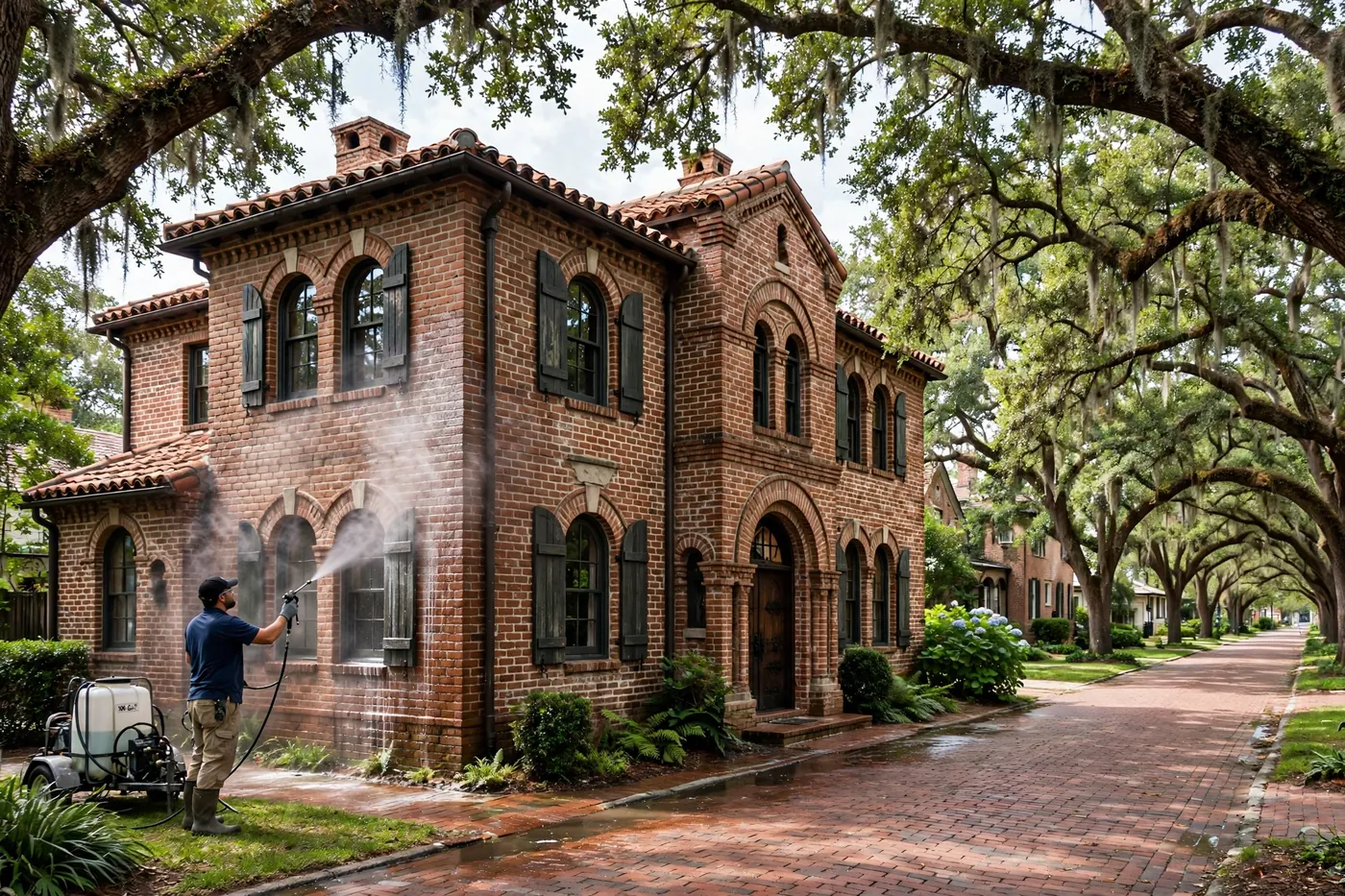
Pressure Washing in San Marco: Brick, Stucco & Historic Homes
San Marco's 1920s–40s Mediterranean Revival homes need a gentle touch. Here's how to clean brick, stucco and historic wood without damage.
Read More →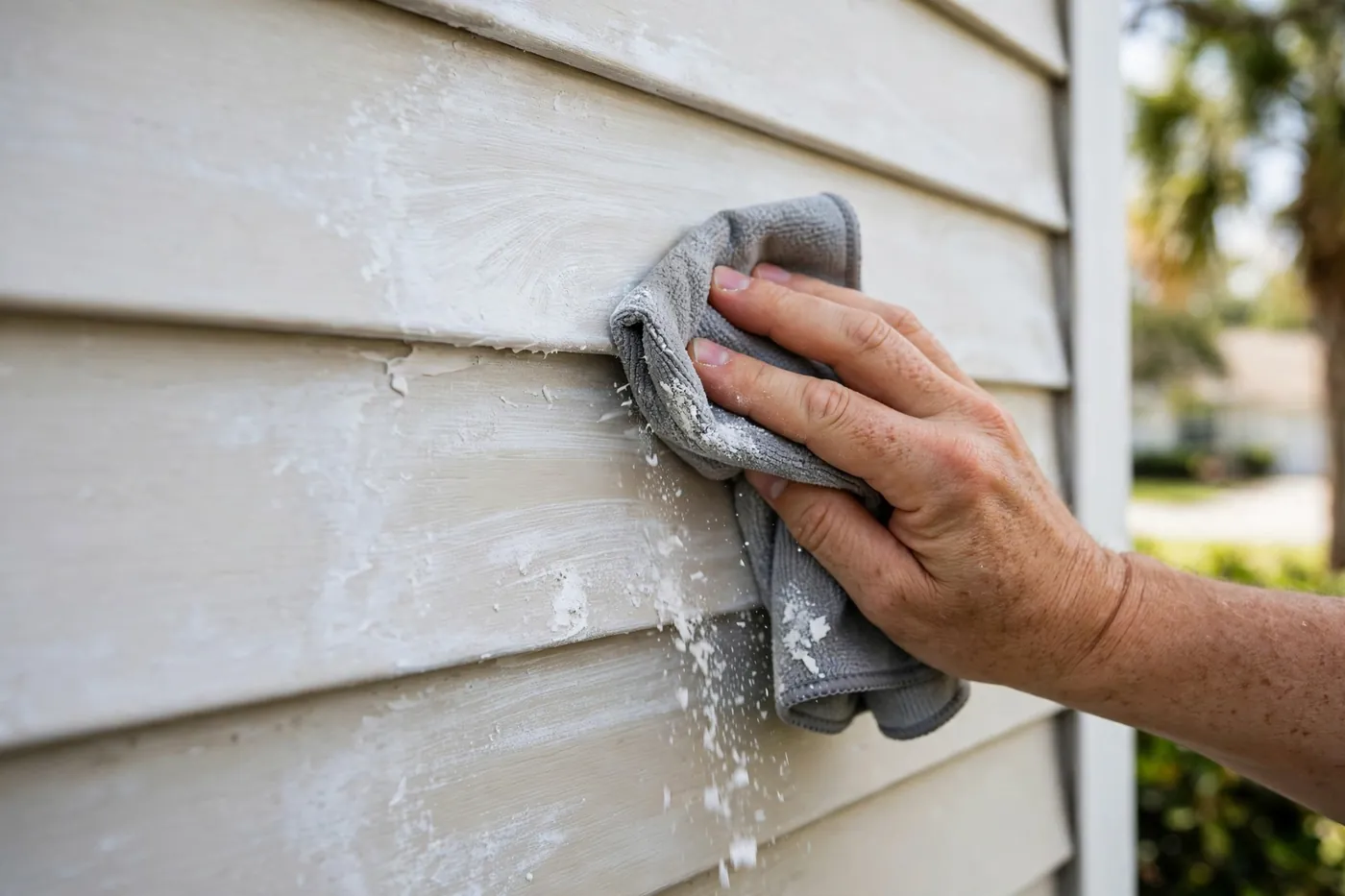
If your hand comes away chalky, that's oxidation. Sometimes it washes off — sometimes the siding is done.
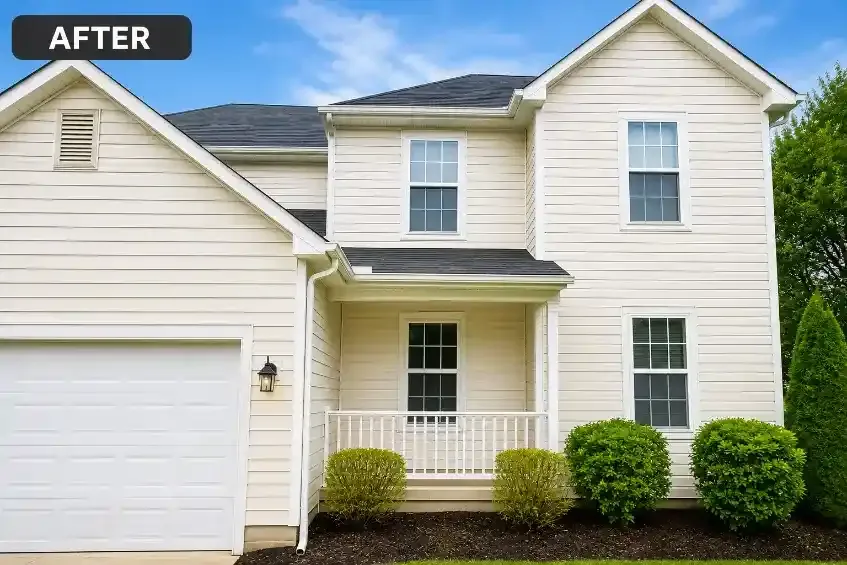
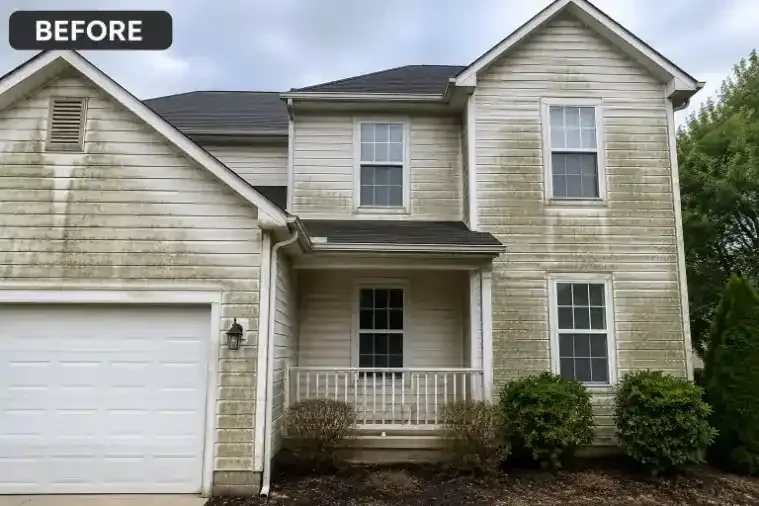 BEFOREAFTER
Drag to compare
BEFOREAFTER
Drag to compareWalk outside, rub your palm firmly across a section of siding on the sunny side of your house, and look at your hand. If it comes away coated in a chalky white or light-colored powder — like the siding is sweating pigment — you are looking at oxidation. It is the breakdown of the vinyl's outer surface from ultraviolet exposure, and in Jacksonville's punishing sun it shows up on south and west walls years before anywhere else.
Oxidation is different from dirt, mildew, and algae, and confusing them leads to bad decisions. Dirt rinses off. Mildew is spotty and organic, usually worst on shaded walls. Oxidation is uniform, chalky, and worst where the sun hits hardest — the exact opposite pattern from mildew. If your shaded north wall is green and your sunny south wall is chalky white, you are looking at two different problems needing two different solutions.
Here is why the distinction matters for anyone researching vinyl siding oxidation removal: washing removes dirt and kills mildew, but oxidation is degraded material, not a surface contaminant. Sometimes the chalky layer washes away to reveal good vinyl underneath. Sometimes the degradation goes all the way through and washing just exposes how far gone it is. Knowing which you have before anyone starts work saves money and disappointment.
Vinyl siding is essentially PVC with UV inhibitors mixed in, and those inhibitors are sacrificial — they get consumed protecting the plastic, and Jacksonville consumes them fast. We get roughly 2700 hours of sunshine a year, much of it intense subtropical UV, and south and west exposures take the full brunt. Darker siding colors oxidize faster and more visibly because they absorb more heat and UV, which is why that deep blue or forest green siding so popular in the 2000s is often the first to chalk.
Age is the other factor. The UV inhibitors in siding from the 1990s and early 2000s were less advanced than today's formulations, and twenty-plus years of Florida sun simply exhausts them. Once the inhibitors are gone, the surface PVC starts breaking down, releasing that chalky residue. It is not a defect or a maintenance failure — it is the material reaching the end of its UV resistance, on schedule.
Salt air accelerates the process on the east side of town. From the Beaches through Ponte Vedra, the combination of UV and salt is measurably harder on siding than UV alone. If your coastal home's siding is chalking at fifteen years while your friend's inland home looks fine at twenty, that is why.
Here is the good news: mild to moderate oxidation often responds beautifully to professional cleaning. The chalky layer is degraded material sitting on top of still-good vinyl, and the right wash removes it to reveal the original color and sheen underneath. We see this constantly on ten-to-fifteen-year-old siding — one wash and the house looks five years younger, with rich color that the owners had forgotten was there.
The method matters enormously. Oxidation must be soft washed — low pressure, appropriate detergents, gentle rinse. High pressure on oxidized siding is a disaster: it drives water behind the panels, can crack brittle older vinyl, and leaves lap marks where the chalk was removed unevenly. We also work in the shade or during cooler hours when possible, because detergents drying too fast on hot oxidized siding leave their own residue.
After a successful oxidation wash, the improvement is immediate and obvious: color depth returns, the chalky hand-test comes back clean, and the siding sheds water properly again. For siding with life left in it, this buys years — often five or more — before the question comes up again. It is one of the highest-value services we offer for the cost.
And here is the honesty this topic demands: sometimes the siding is done, and no wash will change that. The signs are clear once you know them. If the chalky layer is thick and washing reveals vinyl that is still faded, brittle, or discolored underneath — the degradation goes all the way through. If panels crack when flexed gently, or you find cracking around fasteners and corners, the material has lost its structural integrity. If the original color is gone even after the chalk is removed, the pigment itself has broken down.
The twenty-year rule of thumb: vinyl siding in Jacksonville's sun typically gives fifteen to twenty-five years depending on color, quality, and exposure. If yours is pushing twenty and heavily oxidized on multiple exposures, put the wash money toward replacement instead. A wash on truly spent siding is cosmetic theater — it will look briefly better and chalk again within months, because there is no good material left underneath.
We tell customers this straight, even though it costs us the job. We have talked more than a few homeowners out of a wash and into getting replacement quotes, because spending money on a wash that cannot last would be dishonest. That is also why you should be wary of any contractor who promises an oxidation wash will make twenty-five-year-old chalky siding look new — it will not, and they know it.
The way to know which category your siding falls into is a professional evaluation, and it starts with the chalk test plus a few things only experience teaches: how the vinyl flexes, whether the color lives under the chalk or is gone entirely, how the fasteners and J-channels look. A good contractor does this assessment before quoting, not after starting.
What we do at Professor Pressure Washing: we come out, test the siding, and give you one of three answers — it will wash up beautifully, it will improve but has limited life left, or it is time to replace and we will not take your money for a wash. Family-owned in Jacksonville since 2015, we have built the business on exactly this kind of straight talk. Call (904) 938-5900 and get an answer you can trust, whichever direction it points.
Oxidation is UV breakdown of the vinyl's outer surface, appearing as a chalky white powder that rubs off on your hand. It is worst on south and west exposures and on darker colors, and it is different from dirt or mildew — it is degraded material, not surface contamination. Jacksonville's intense sun accelerates it significantly.
Mild to moderate oxidation, yes — professional soft washing removes the chalky degraded layer to reveal good vinyl underneath, often making the house look years younger. But it must be soft washed; high pressure damages oxidized siding. And if the degradation goes all the way through, washing only exposes how far gone it is.
When the vinyl is faded or discolored even after the chalk is removed, when panels crack or feel brittle, or when siding is past twenty years with heavy oxidation on multiple exposures. At that point the material is spent and wash money is better put toward replacement — we will tell you honestly which situation you are in.
San Marco's 1920s–40s Mediterranean Revival homes need a gentle touch. Here's how to clean brick, stucco and historic wood without damage.
Read More →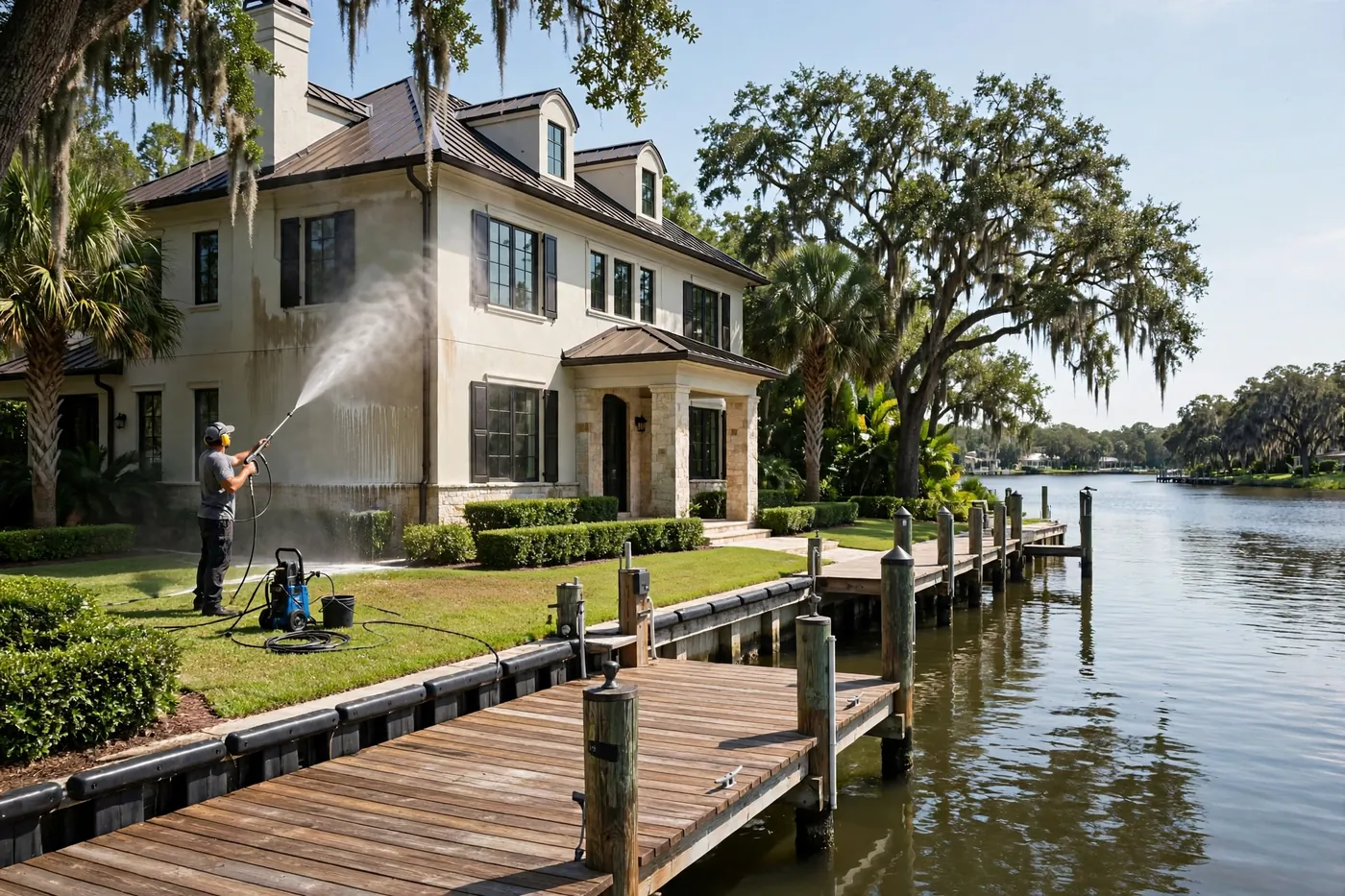
Ortega's riverfront estates face salt air, river humidity and dock grime. A complete guide to waterfront exterior cleaning.
Read More →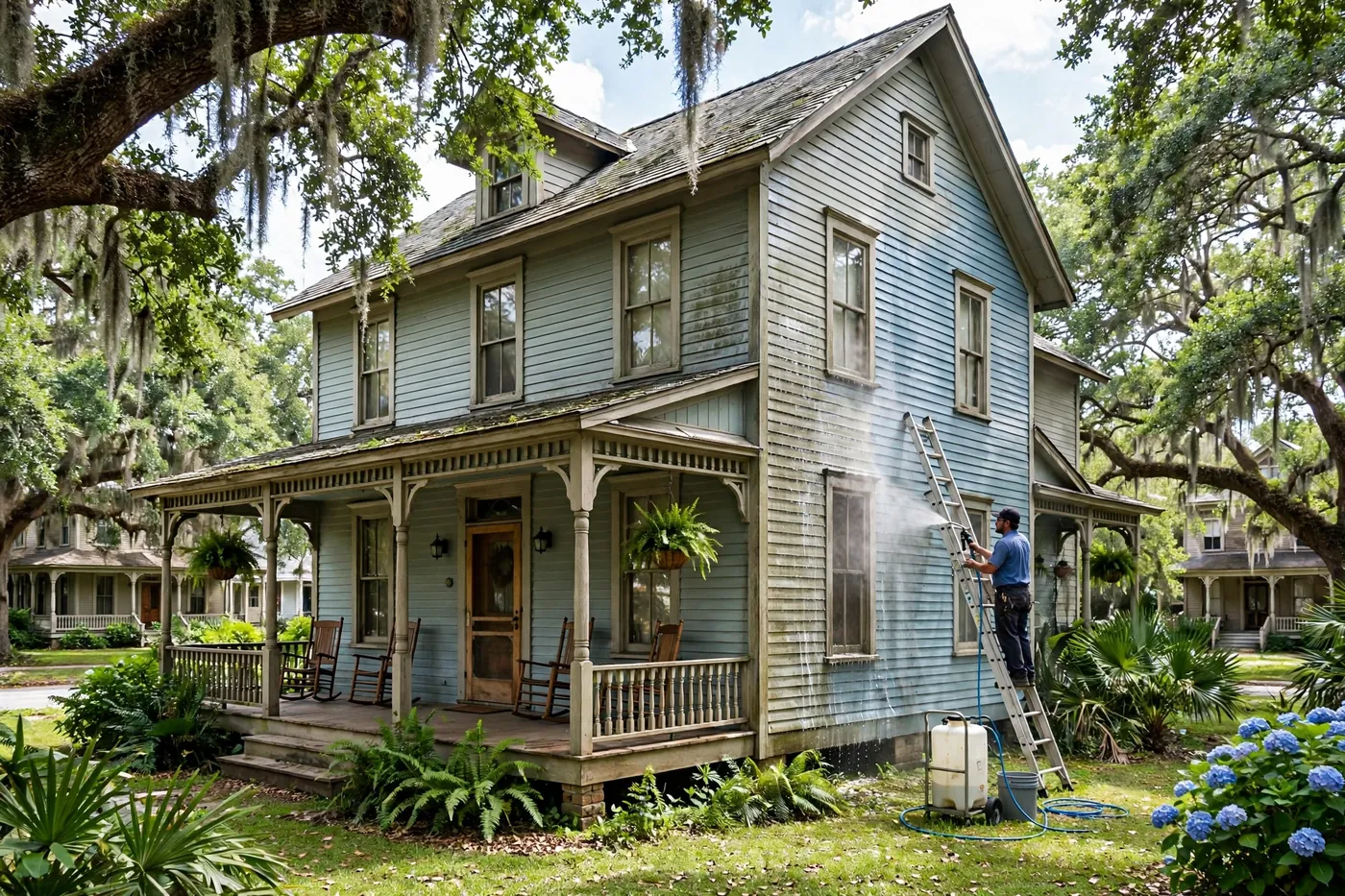
Springfield's century-old homes need soft washing, not brute force. How to restore historic siding safely.
Read More →Call now for a free estimate and same-day service in Jacksonville, FL. Open 24/7.