
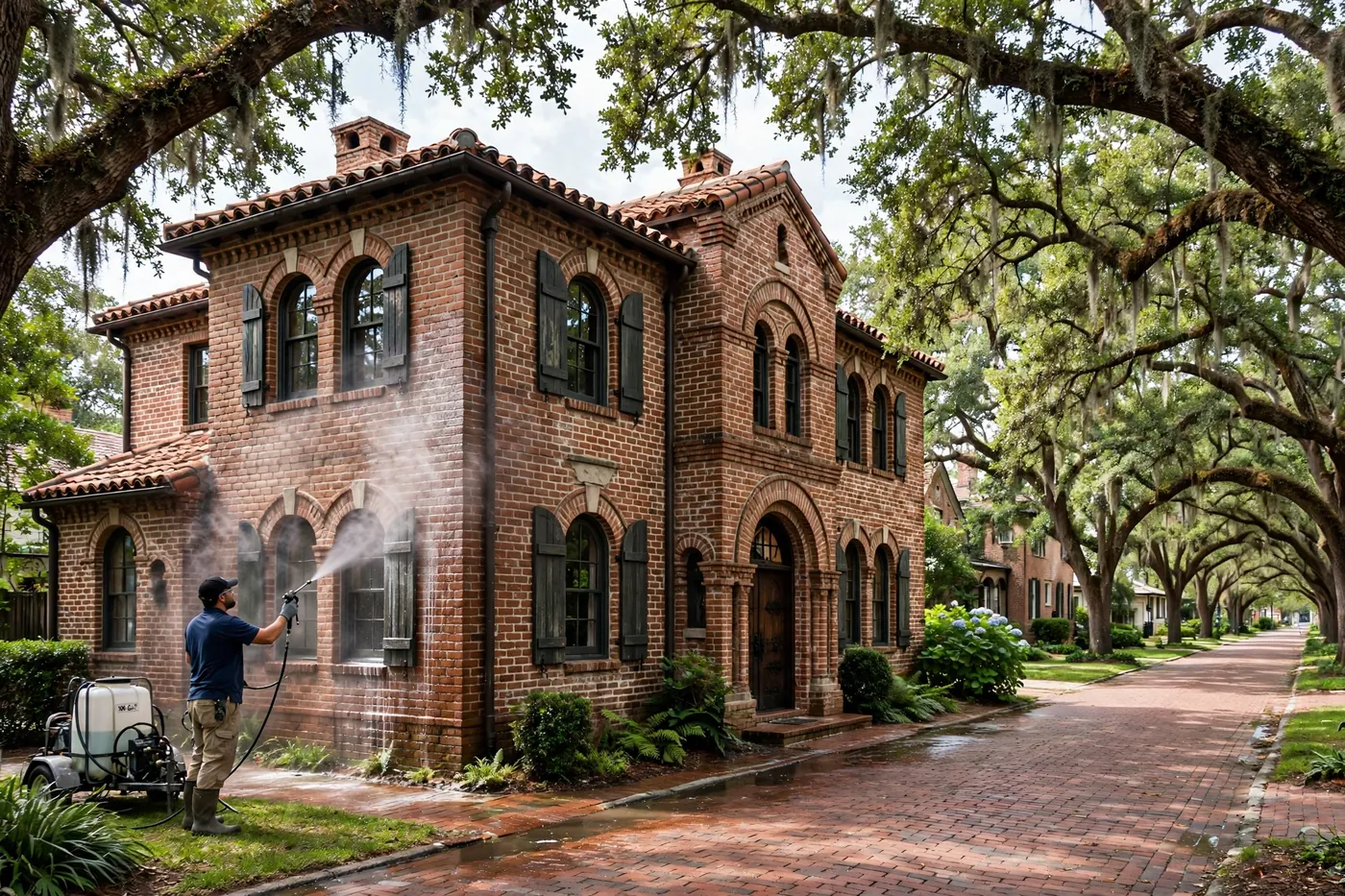
Pressure Washing in San Marco: Brick, Stucco & Historic Homes
San Marco's 1920s–40s Mediterranean Revival homes need a gentle touch. Here's how to clean brick, stucco and historic wood without damage.
Read More →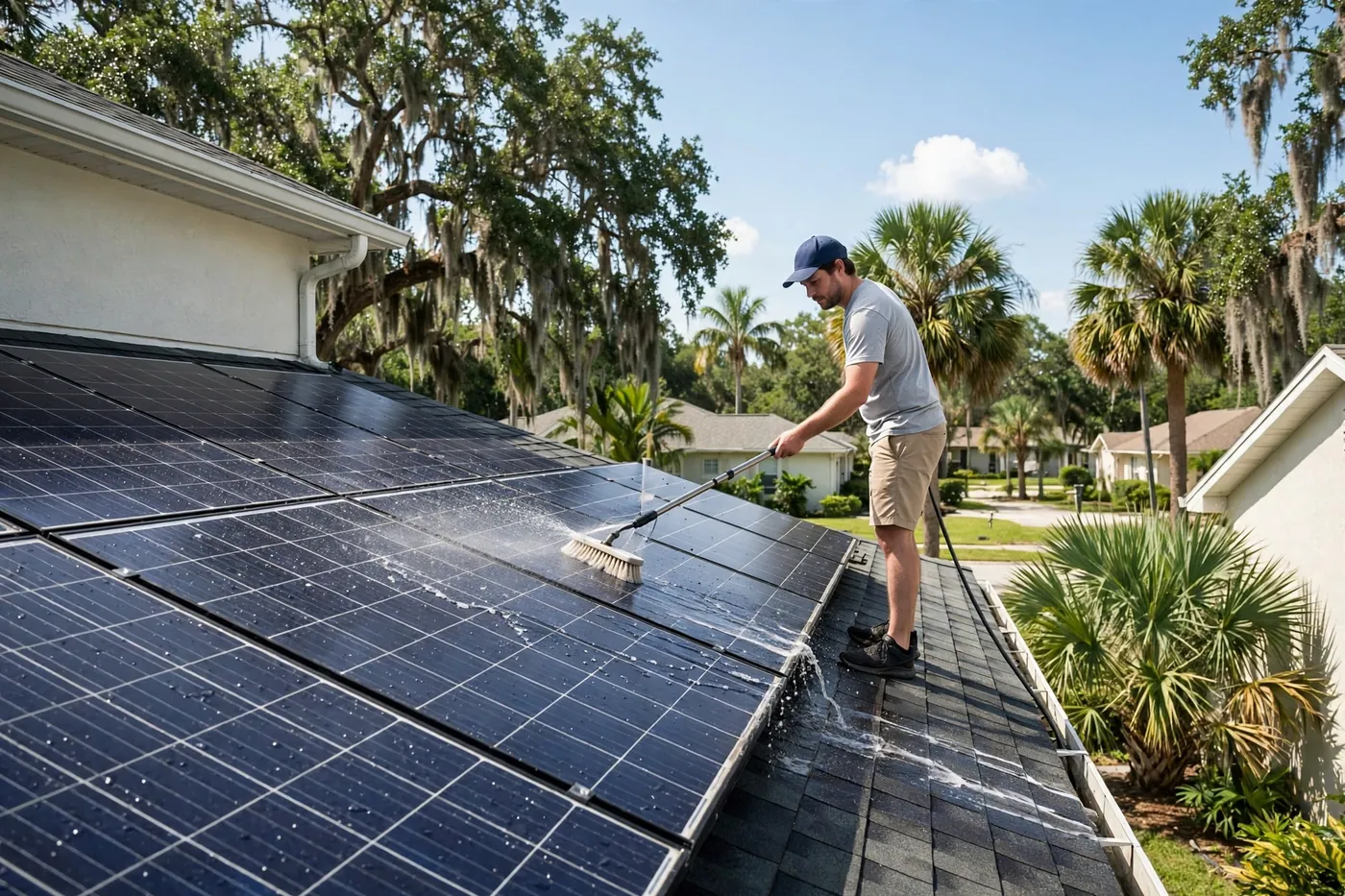
Oak pollen and salt film can cut panel output significantly. Safe cleaning restores production.
 BEFOREAFTER
Drag to compare
BEFOREAFTER
Drag to compareEvery March through May, Jacksonville disappears under a yellow-green blanket of oak pollen — the live oaks of Mandarin, Ortega, and San Marco are magnificent and merciless. That same pollen settles on rooftop solar arrays in a sticky film that does not rinse off in rain; in fact, spring showers bake it into a stubborn haze. Add the salt film that drifts inland from the Atlantic year-round, and Jacksonville panels carry a soiling load most solar installers never warned you about.
The efficiency cost is real and well-documented. Industry studies consistently show soiled panels losing anywhere from 5 percent to 25 percent of output depending on soiling severity, with pollen-heavy regions like ours sitting uncomfortably high in that range. On a typical Jacksonville residential array, a 15 percent soiling loss can mean hundreds of dollars a year in foregone production — silently, month after month, while the panels look 'fine' from the ground.
Most owners never connect the dots because the loss is gradual. Your monitoring app shows a slow decline you attribute to weather or seasons. Then someone cleans the panels and production jumps 10 to 20 percent overnight. We see that reveal regularly, and it is the single best argument for treating panel cleaning as maintenance, not vanity.
Solar cells are wired in series, which means the dirtiest cell limits the whole string — a concept installers call the 'Christmas light effect.' A pollen-caked lower edge or a bird-dropping hotspot does not just reduce that spot's output; it drags down every panel wired with it. Partial soiling is disproportionately damaging, which is why the patchy, streaky film Jacksonville roofs develop is worse than uniform dust.
There is also a heat dimension. Dark soiling absorbs heat, and solar panels lose efficiency as they get hotter — roughly half a percent per degree above standard test conditions. A grimy panel in a Jacksonville July is running hotter than a clean one, compounding the optical loss with thermal loss. It is a double penalty unique to dirty panels in hot climates.
Long-term, neglected soiling causes its own damage. Organic matter holds moisture against the glass, encouraging the growth of lichen in shaded array corners — and lichen etches glass microscopically if left for years. Bird droppings are acidic enough to stain anti-reflective coatings. Cleaning is not just about today's kilowatt-hours; it protects a twenty-five-year asset.
Here is the most important thing in this article: never let anyone pressure wash your solar panels. High-pressure water can crack cells, force moisture past seals into the junction box, and void manufacturer warranties that explicitly exclude pressure damage. Panels are also slippery when wet and often near roof edges — the fall risk is real. If a contractor proposes to 'blast' your array, that conversation is over.
Professional panel cleaning is deliberately gentle: deionized or purified water (so it dries spot-free), soft brushes or cloths, and zero abrasives. We work from ladders and roof anchors — never walking on the panels themselves, which can micro-crack cells underfoot — and we clean in the cool of morning or evening, because thermal shock from cold water on hot glass is a genuine cracking risk in Florida.
Detergents are a judgment call. Most manufacturer guidance favors pure water alone; we use it exclusively unless hard-water spotting or stubborn organic growth demands a panel-safe surfactant, and we rinse completely either way. The goal is glass so clean it disappears — maximum light transmission, zero residue, zero risk to the array.
For most Jacksonville homes, the honest answer is two to four times per year, anchored to local realities. Cleaning number one comes in late May or June, right after oak pollen season ends — this is the highest-value wash of the year, restoring the output pollen stole all spring. Cleaning number two lands in fall, after hurricane season's wind-driven grime and before the lower winter sun angle makes every percentage point count.
Homes near the beaches — Jacksonville Beach, Neptune Beach, Ponte Vedra — should lean toward the higher end, because salt film accumulates continuously and does not wait for pollen season. Homes under heavy oak canopy in Ortega or Avondale get the pollen worst and may want a mid-spring touch-up in heavy years. Arrays near construction, like the growth corridors of Nocatee and eTown, collect dust that justifies an extra pass.
Your monitoring app is the ultimate guide: if production drops 5 percent or more from its clean baseline in similar weather, the panels are telling you they are dirty. We are happy to do a first cleaning and help you establish that baseline — then the data makes the schedule obvious.
Run the numbers honestly. A typical Jacksonville residential array (say, 8 kilowatts) in good sun produces roughly 11,000 to 12,000 kilowatt-hours per year. At JEA's residential rates, a 10 percent soiling loss — conservative for a pollen-season array — costs on the order of $130 to $170 annually in lost production. Two professional cleanings per year cost less than that recovered value for most homes, before counting the protection against long-term glass and coating damage.
The math improves for larger arrays and for homes on time-of-use or high-tier rates, and it is most compelling right after pollen season, when a single cleaning can restore the year's biggest loss in one visit. What does not pencil out is DIY: the purified water, proper brushes, roof safety equipment, and your Saturday are worth more than the service call — and the warranty risk of a misstep is entirely yours.
Professor Pressure Washing is family-owned and has served Jacksonville since 2015. If your monitoring app has been drifting downward, or pollen season just ended, call (904) 938-5900. We will clean your array the safe way — no pressure, no walking on panels, no residue — and let your production numbers tell the rest of the story.
Documented soiling losses range from about 5 percent for light dust to 25 percent for heavy organic soiling, with pollen-heavy regions like Jacksonville commonly seeing 10 to 20 percent during and after oak pollen season. Because cells are wired in series, even patchy soiling drags down whole strings. Most owners are surprised how much a single cleaning restores — the monitoring app usually tells the story within days.
We never walk on the panels themselves — foot traffic can micro-crack solar cells, and most manufacturers exclude such damage from warranty. We work from ladders and proper roof anchors, clean in the cool of morning or evening to avoid thermal shock to hot glass, and use only soft brushes with purified water. If roof access is unsafe, we will tell you that honestly rather than improvise.
Two to four times per year for most Jacksonville homes: once right after oak pollen season ends (late May/June), once after hurricane season in fall, with extra passes for beach-area homes dealing with year-round salt film or homes under heavy oak canopy. Your monitoring app is the best guide — a 5 percent-plus drop from baseline in similar weather means it is time.
San Marco's 1920s–40s Mediterranean Revival homes need a gentle touch. Here's how to clean brick, stucco and historic wood without damage.
Read More →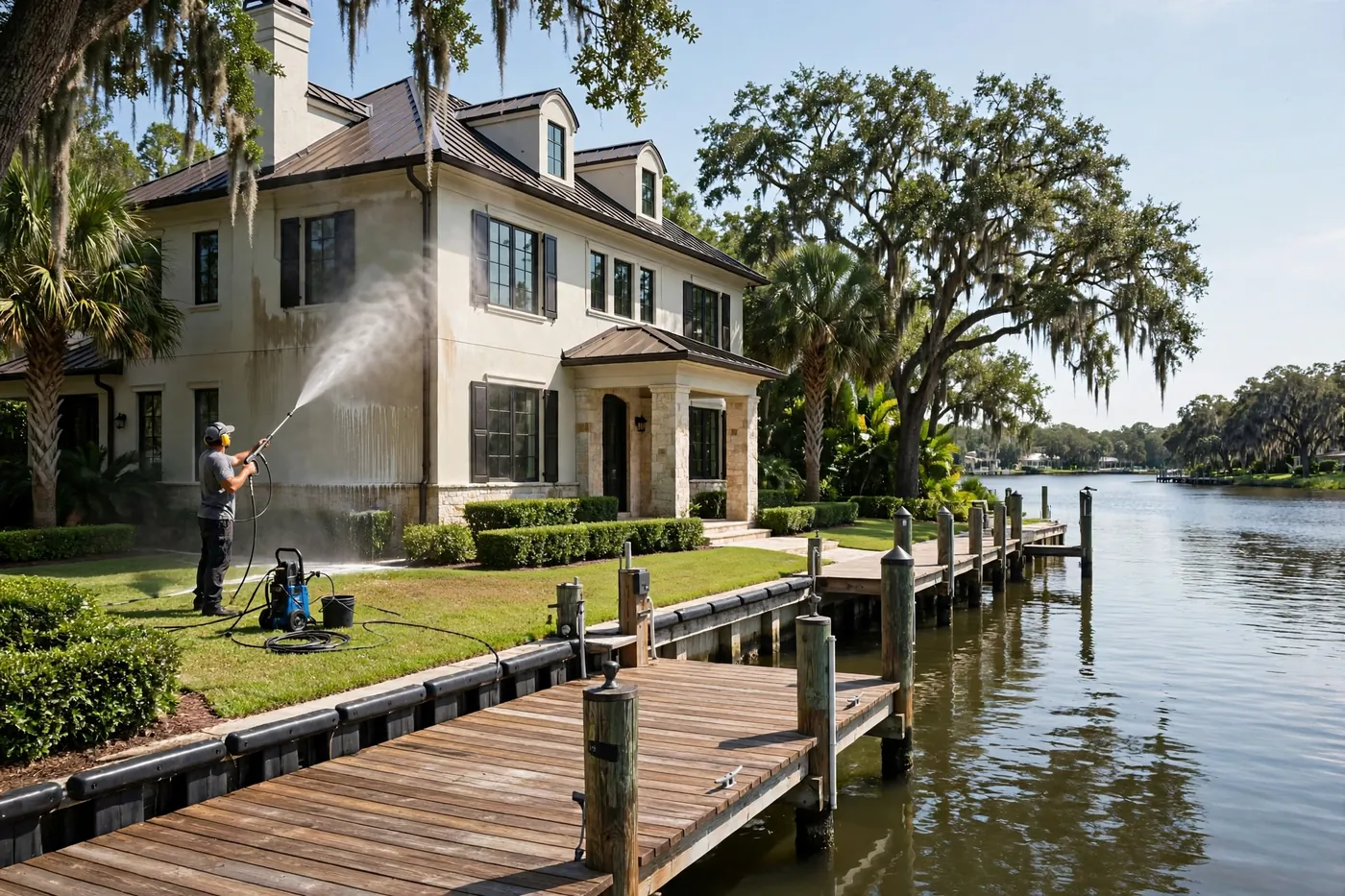
Ortega's riverfront estates face salt air, river humidity and dock grime. A complete guide to waterfront exterior cleaning.
Read More →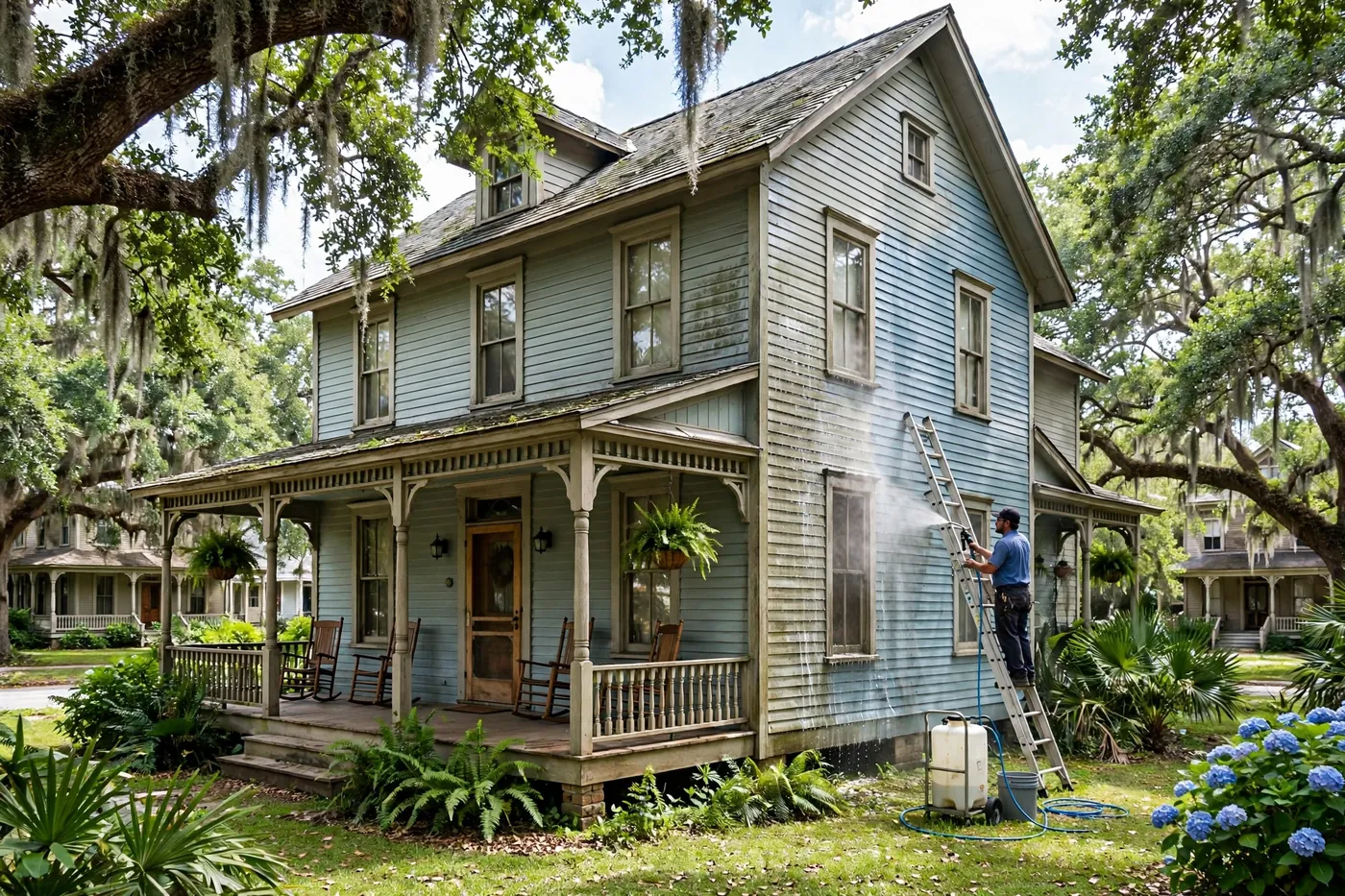
Springfield's century-old homes need soft washing, not brute force. How to restore historic siding safely.
Read More →Call now for a free estimate and same-day service in Jacksonville, FL. Open 24/7.