
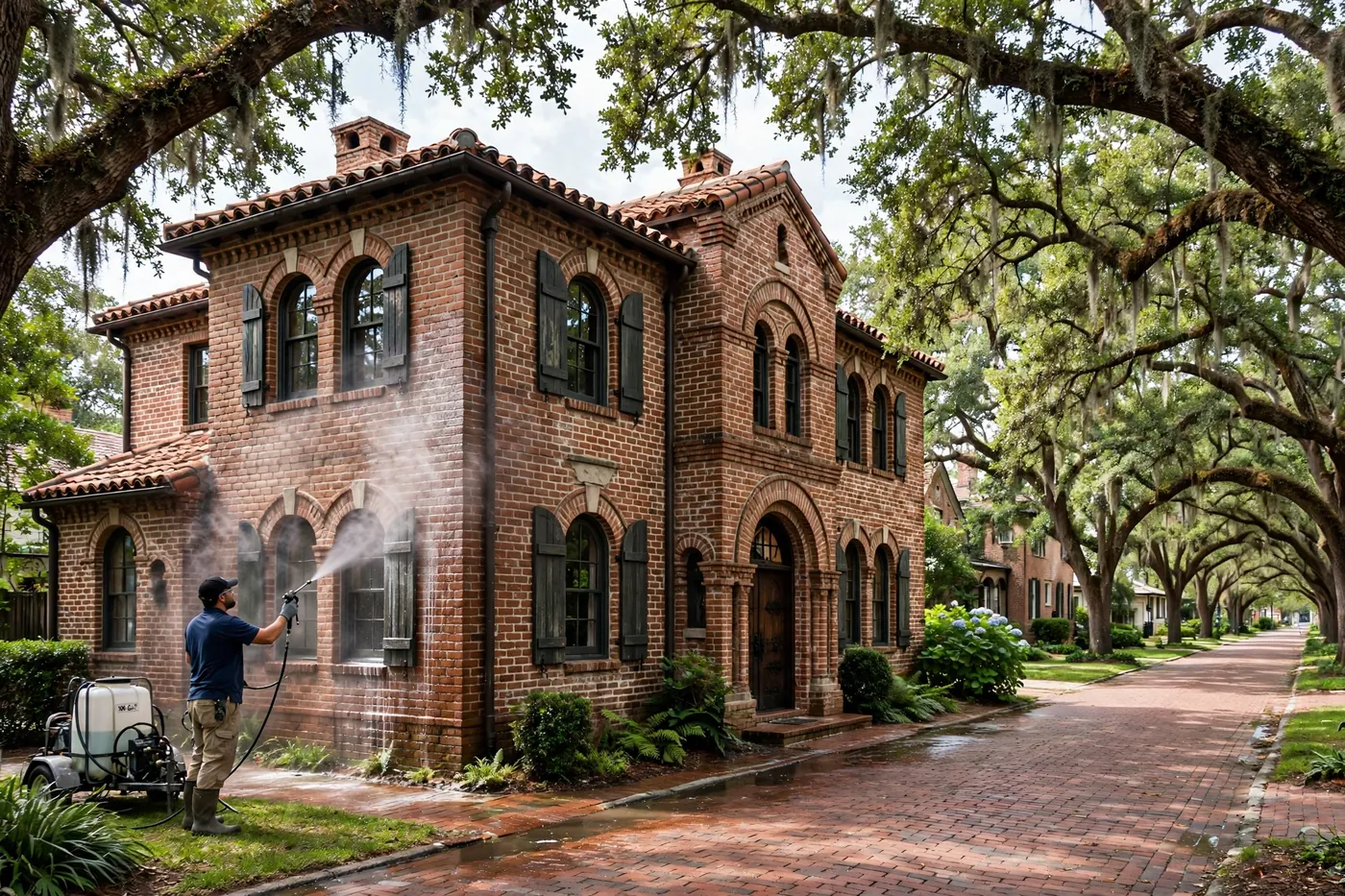
Pressure Washing in San Marco: Brick, Stucco & Historic Homes
San Marco's 1920s–40s Mediterranean Revival homes need a gentle touch. Here's how to clean brick, stucco and historic wood without damage.
Read More →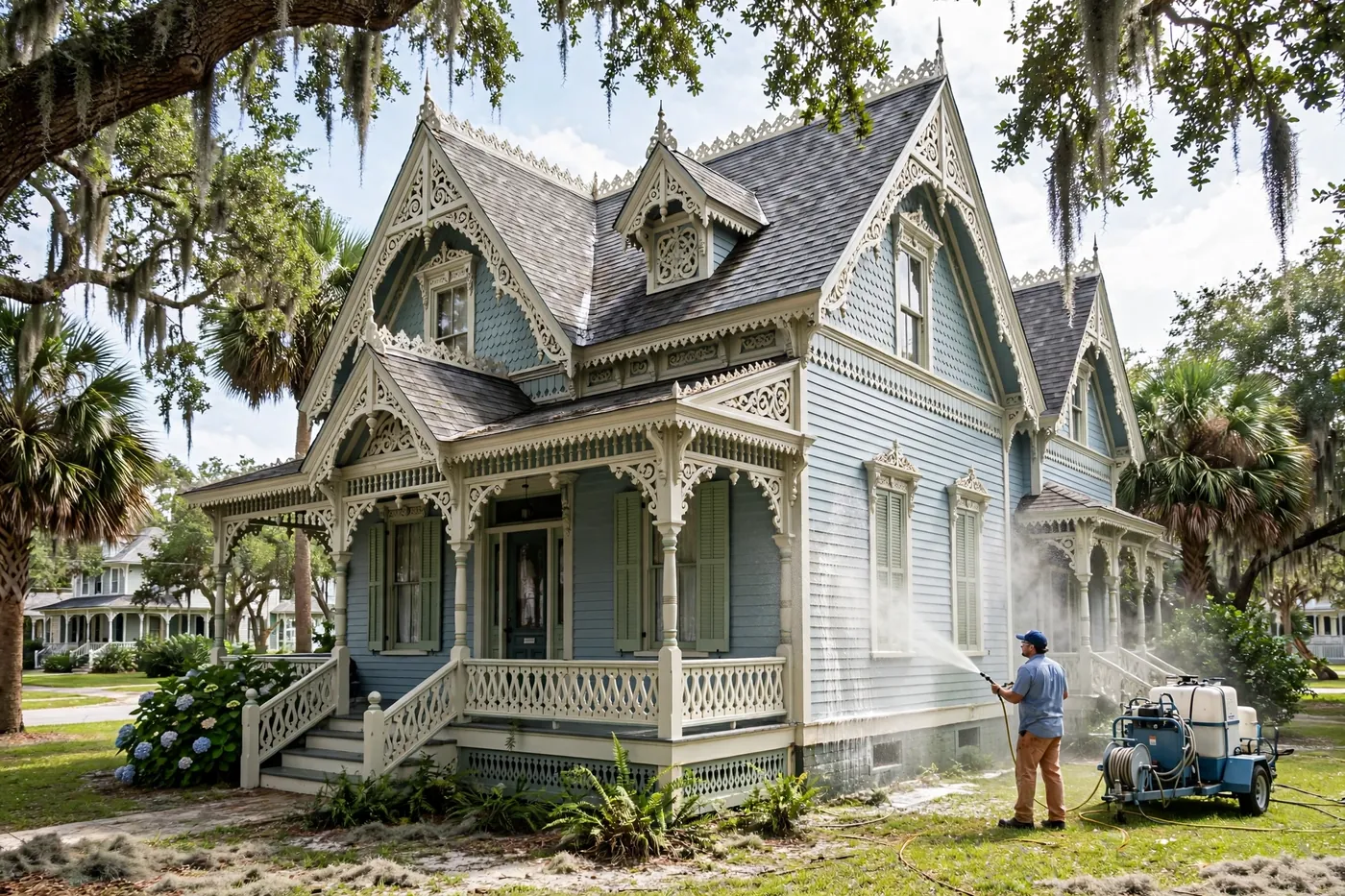
Amelia Island's Victorian homes and historic downtown face island-specific salt and sand challenges.
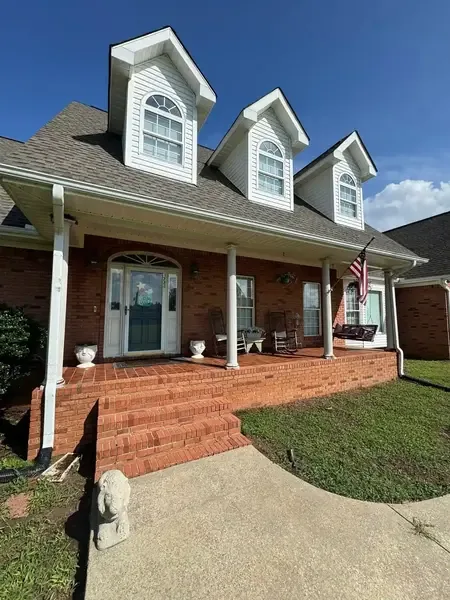
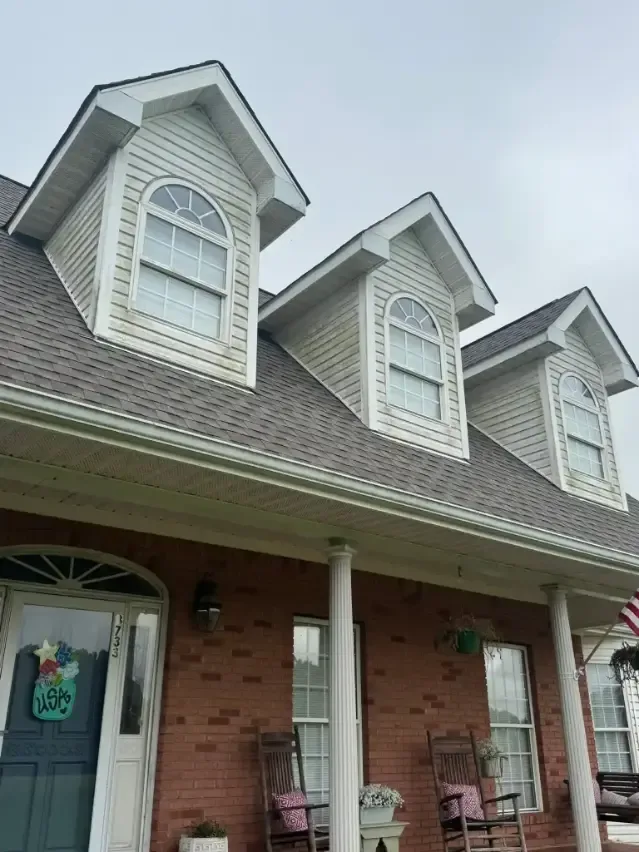 BEFOREAFTER
Drag to compare
BEFOREAFTER
Drag to compareEvery coastal town gets salt air, but an island gets it from every direction. Fernandina Beach sits at the northern tip of Amelia Island with the Atlantic on one side and the Amelia River and marsh on the other, which means there is no upwind side — salt-laden air wraps the whole town. Anyone searching for pressure washing Fernandina Beach FL is dealing with a heavier, more constant salt load than even Jacksonville Beach sees.
What salt actually does to exteriors is insidious. It is hygroscopic, meaning it pulls moisture out of the air and holds it against the surface, so salted siding stays damp longer after every rain and every humid morning. That extended dampness is what feeds the mildew and algae that turn island homes green and gray. Salt also accelerates corrosion on anything metal — light fixtures, railings, hurricane shutters, door hardware — and it dulls paint faster than sun alone.
The practical upshot: island homes need washing more often than identical homes ten miles inland, and the wash needs to actually remove the salt film, not just the visible mildew. Detergents that break down salt deposits matter here in a way they do not in Mandarin. If your last wash looked good for three months and then the green came roaring back, salt was probably still in the pores.
The historic district's Victorians — the gingerbread trim, the ornate brackets, the century-old heart-pine siding on streets like Ash and Beech — are irreplaceable, and they demand the gentlest methods we own. This is exclusively soft-wash territory: detergents applied at low pressure, dwell time doing the work, and a rinse so gentle it would not disturb a spiderweb. Anything stronger risks carving into old wood, blowing apart fragile trim joints, and forcing water into wall cavities where it becomes tomorrow's rot.
Old paint is the other consideration. Many of these homes wear paint that is decades old and chalking, and washing will reveal exactly how much life is left in it. We always test first and we are blunt about what we find: if the paint is powdering off on your hand, washing will take the loose paint with it, and the right sequence is paint first, wash later — or wash gently now knowing a paint job is in your near future. We would rather have that honest conversation upfront than surprise you mid-job.
Wood rot gets the same honesty. Soft, punky trim boards and window sills need a carpenter, not a pressure washer, and we will point out what we see. Catching rot early is the difference between replacing a six-inch section of trim and rebuilding a whole corner.
Centre Street is the economic heart of the island, and its historic brick and stucco storefronts take a beating from the specific cocktail of tourism: foot traffic grinding sand into sidewalks, cooking grease near the restaurants, and the general film that thousands of visitors a week leave behind. For a shop or restaurant here, the storefront is the advertisement — and the competition two doors down just washed theirs.
We do downtown commercial work in the early morning hours, typically starting before sunrise and finished before the breakfast crowds. Sidewalks get the surface cleaner for an even finish without stripes, facades get soft washed to protect old brick and stucco, and we pay special attention to entryways and outdoor dining areas where grease and gum concentrate. The shrimp docks and working waterfront nearby add their own character — and their own grime — to the south end of downtown, and we factor that in.
For property managers with multiple island buildings, we can put the whole portfolio on a rotating schedule so something is always freshly done. Consistency beats intensity for commercial curb appeal.
Beyond salt, the island's daily grime has its own local flavor. Windblown sand works into every textured surface — stucco, tabby, paver joints — and acts like sandpaper on paint every time the wind blows. Near the waterfront and the shrimp docks, there is an additional organic film from the working harbor that settles on everything downwind. And the live oaks that shade so many island streets contribute their usual tannin and shade-algae.
Sand is worth taking seriously because it is abrasive, not just dirty. Letting it accumulate on painted surfaces measurably shortens paint life as wind grinds it against the finish. Regular washing that actually removes the embedded sand — not just the surface dust — protects the paint underneath. This is one of those cases where the wash is genuinely preventive maintenance, not cosmetic.
Pool decks and outdoor living spaces take the same beating, with the added insult of sunscreen and salt from swimmers. If your island pool deck is slippery, that slickness is biofilm, and it is a fall risk. It washes off completely and the deck stays safer for months.
For a Fernandina Beach home, plan on every twelve months as the baseline — the island's salt load simply does not allow the eighteen-to-twenty-four-month intervals that work inland. Homes right on the beach or the river, and homes under heavy oak canopy, trend toward every nine to twelve months. Commercial properties on Centre Street do best on a six-to-twelve-month rotation depending on foot traffic.
Late spring is the island's sweet spot: after the oak pollen apocalypse, before hurricane season, and ahead of the summer visitor rush when you want everything looking its best. Professor Pressure Washing is family-owned and has served Northeast Florida since 2015 — the island is familiar ground for us. Call (904) 938-5900 and we will give you an honest assessment and a straightforward quote, no pressure and no upsell.
Amelia Island gets salt from every direction — Atlantic on one side, river and marsh on the other — with no upwind side. Salt holds moisture against surfaces longer, feeding faster mildew growth and corroding metal fixtures, so island homes need washing more often and need the salt film actually removed, not just the visible growth.
Yes, we do Centre Street commercial work in the early morning before businesses open. Sidewalks, facades, entryways, and outdoor dining areas are the usual scope, with methods matched to historic brick and stucco. Multi-property portfolios can go on a rotating schedule.
Twelve months is the baseline for most island homes; beachfront, riverfront, or heavily shaded properties trend toward nine to twelve. Late spring — after pollen season, before hurricane season — is the ideal window.
San Marco's 1920s–40s Mediterranean Revival homes need a gentle touch. Here's how to clean brick, stucco and historic wood without damage.
Read More →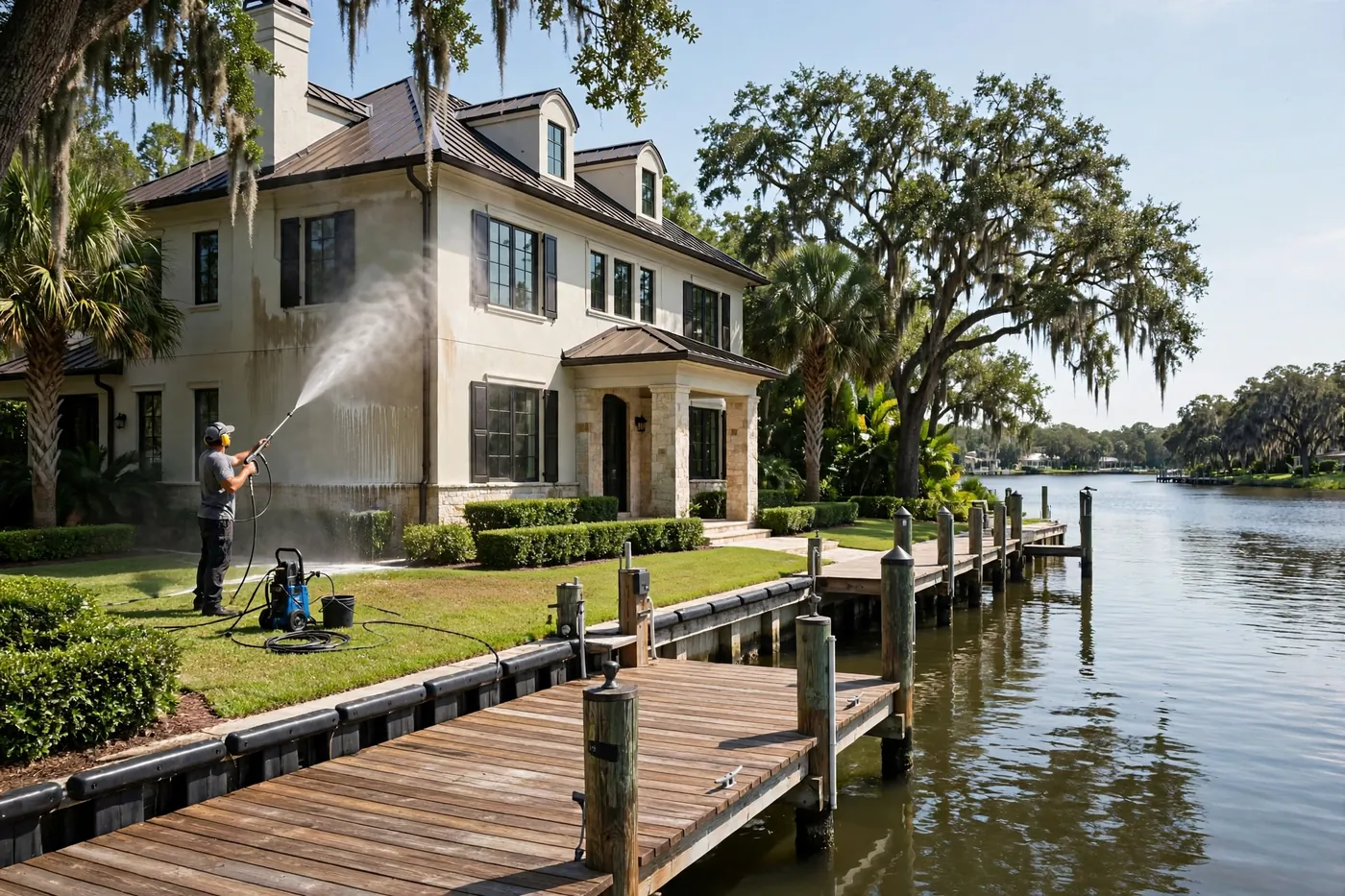
Ortega's riverfront estates face salt air, river humidity and dock grime. A complete guide to waterfront exterior cleaning.
Read More →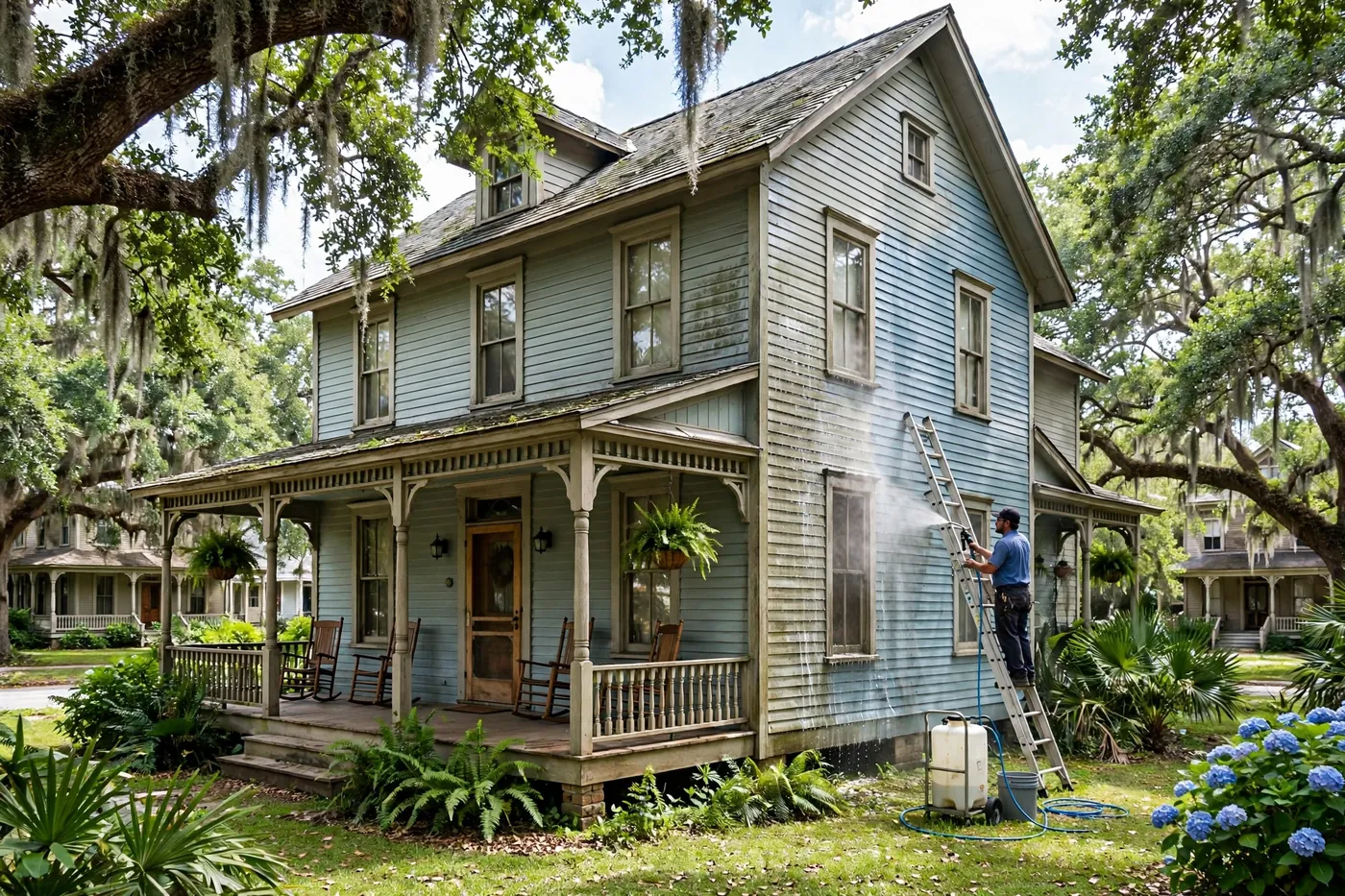
Springfield's century-old homes need soft washing, not brute force. How to restore historic siding safely.
Read More →Call now for a free estimate and same-day service in Jacksonville, FL. Open 24/7.
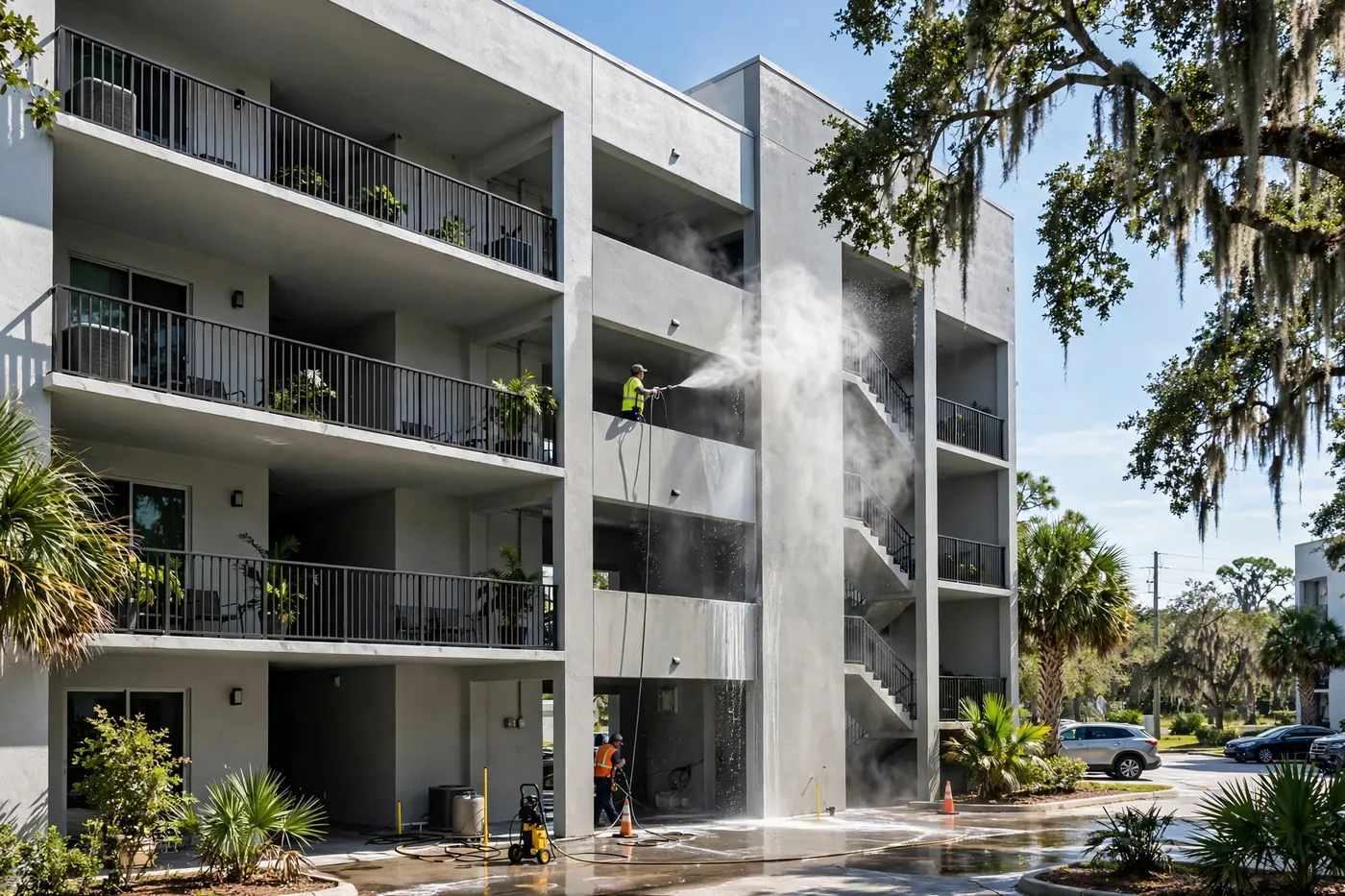
Condo exterior cleaning: what the HOA covers, what you pay for, and how to get it scheduled.
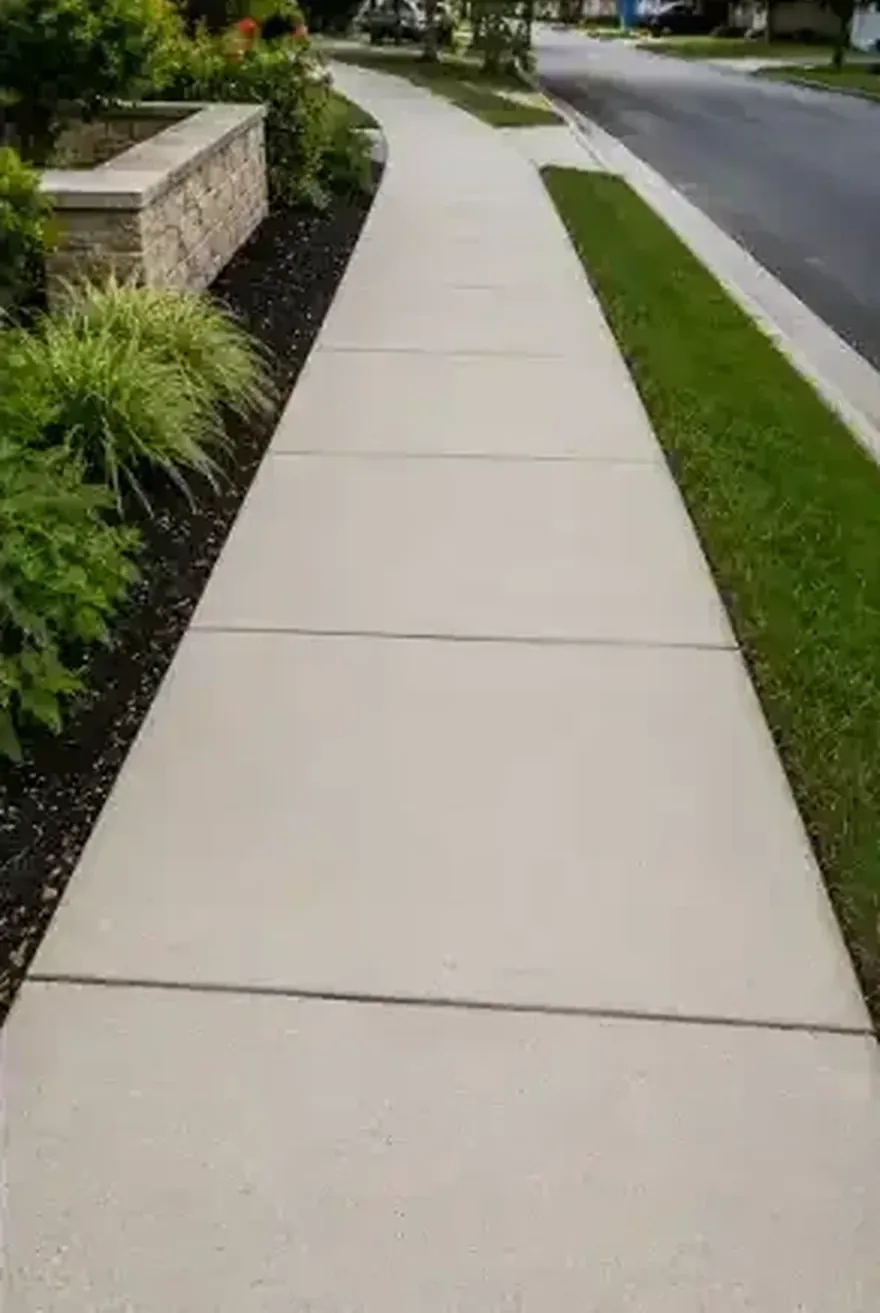
 BEFOREAFTER
Drag to compare
BEFOREAFTER
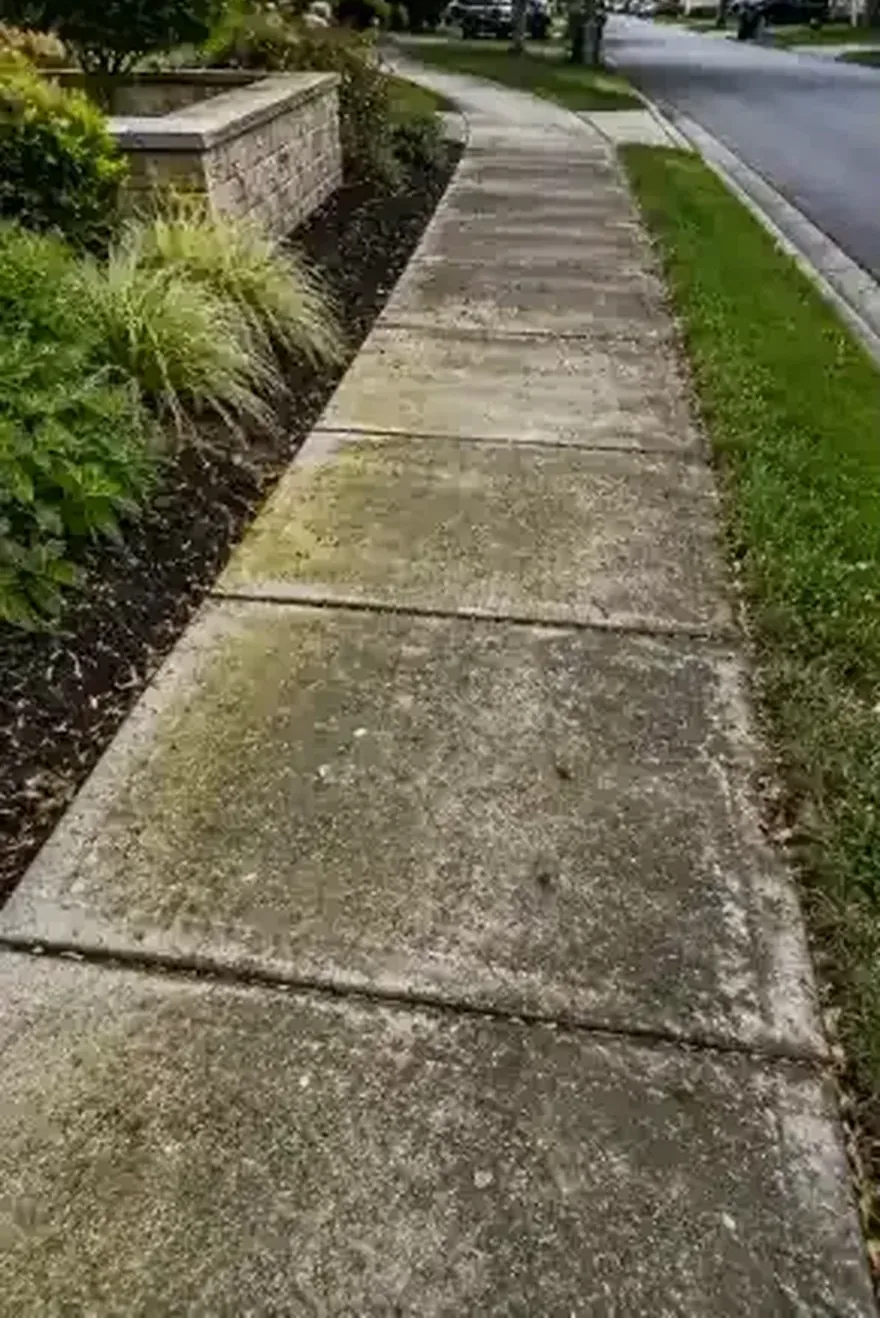
Drag to compareThis is the question behind nearly every condo pressure washing Jacksonville inquiry we get, and the honest answer is: it depends on your building's documents. But there are strong patterns across the Baymeadows corridor, Southside, and Deerwood area complexes. In most garden-style and mid-rise condos, the HOA or condo association is responsible for the building exterior — siding, common walkways, breezeways, stairwells, and parking areas — funded through your monthly dues. The unit owner is typically responsible for their exclusive-use areas: the balcony or patio slab, and sometimes the windows and screens.
The gray areas are where the arguments start. Is the concrete pad of your ground-floor patio exclusive-use or common area? Who owns the mildew on the wall facing your balcony? Your declaration and bylaws answer these, usually in the maintenance section, but plenty of owners have never read that far. Before you pay out of pocket for anything beyond your front door, check the documents — you may already be paying for it in your dues.
When the HOA is responsible but slow to act, individual owners sometimes hire us for just their section — a balcony, a patio, the walkway to their door. We do these small jobs regularly. But if the whole building is green, one clean balcony just highlights the problem, and the real fix is getting the board to schedule a building-wide wash.
If you have ever walked a Baymeadows condo breezeway in August, you know the smell: damp concrete, mildew, and whatever the second-floor neighbor's cooking vented that morning. Breezeways and interior stairwells are the highest-traffic, lowest-ventilation surfaces in the building, and in Jacksonville's humidity they grow a biofilm that is both ugly and genuinely slippery. These are common areas, squarely the HOA's responsibility, and they are usually the most visibly neglected.
Cleaning them properly takes more than a wand and a prayer. Standing water has to go somewhere — we manage drainage so we are not flooding ground-floor patios or pushing dirty water under doors. Railings get hand-detailed because residents touch them. And we work building by building, section by section, so residents always have a dry path to their doors. It is methodical work, and it is the fastest way to make an aging complex look a decade younger.
Parking garages and surface lots are the other big common-area item. Oil spots, tire marks, and the general gray film of exhaust accumulate until the whole garage feels dingy and unsafe. A professional garage wash — usually scheduled overnight or in phases — transforms how residents feel about coming home after dark.
Your balcony or patio is almost always your responsibility, and it is also the exterior surface you actually live with. Second-floor balconies collect mildew on railings and green film on the slab where the AC condensate drips. Ground-floor patios get leaf tannin, irrigation rust, and the slow creep of algae from the lawn edge. Because these are small areas, they are also quick and affordable to clean — most take under an hour.
A practical tip for balcony owners: check your railing type before anyone washes it. Painted aluminum railings common in 1980s Baymeadows buildings can be chalky with oxidation, and aggressive washing strips the remaining paint. We soft wash railings and will tell you honestly if the paint is too far gone for washing to help — sometimes the right answer is a wash plus a fresh coat of paint, in that order.
Also mind your neighbors below. Water and detergent from a second-floor balcony goes straight down to the first-floor patio. We always work top-down and notify affected units, which is one reason individual balcony jobs go smoother when the building coordinates them together.
Building-wide condo washes are logistics projects, and the good ones are invisible to residents. Here is how we run them: first a walkthrough with the property manager to map water sources, drainage, parking impacts, and any problem areas. Then a notice to residents — usually 48 to 72 hours — explaining which days their building section is being done, where to move cars, and to keep windows closed and balcony items inside.
We phase the work so no building is ever fully blocked. Breezeways get done in halves with a dry path maintained. Water is the other planning item: we need spigot access, and on large complexes we sometimes bring our own supply to avoid draining the building's system or fighting for pressure with residents' morning showers. A typical garden-style building takes a day; a full complex runs several days to a couple of weeks depending on size.
For boards getting bids, ask every contractor the same three questions: how do you handle resident notification, how do you manage water and drainage, and what is your plan if it rains mid-job. The answers tell you immediately who has done this before.
If you are an owner trying to convince a reluctant board, lead with liability and asset value, not aesthetics. Slippery breezeways and stairwells are a slip-and-fall risk the association owns. Visible mildew depresses resale values for every unit, not just yours — appraisers and buyers photograph exteriors first. And deferred cleaning gets more expensive: algae left for years roots deeper and takes longer (read: costs more) to remove.
Bring a specific proposal, not a complaint. Get a written quote with scope, schedule, and resident-notification plan, and present it at the meeting. Boards say yes to turnkey plans far more often than to vague requests. Professor Pressure Washing has been family-owned in Jacksonville since 2015 and we provide exactly that kind of board-ready proposal — scope, phasing, and all. Call (904) 938-5900 and we will walk the property with your manager and put it in writing.
Usually the HOA covers the building exterior, breezeways, stairwells, walkways, and parking areas through your dues, while you cover your balcony or patio. But every building's declaration is different, so check your documents before paying out of pocket — you may already be paying for it.
Almost always the unit owner, since these are exclusive-use areas. They are small, quick jobs — most take under an hour. Just check railing paint condition first, and coordinate with the unit below since water runs downhill.
In phases, with 48 to 72 hours resident notice, cars moved, and a dry path always maintained. We map water sources and drainage with the property manager first, and a typical garden-style building takes about a day. Ask any bidder about notification, drainage, and rain plans.
San Marco's 1920s–40s Mediterranean Revival homes need a gentle touch. Here's how to clean brick, stucco and historic wood without damage.
Read More →Ortega's riverfront estates face salt air, river humidity and dock grime. A complete guide to waterfront exterior cleaning.
Read More →Springfield's century-old homes need soft washing, not brute force. How to restore historic siding safely.
Read More →Call now for a free estimate and same-day service in Jacksonville, FL. Open 24/7.
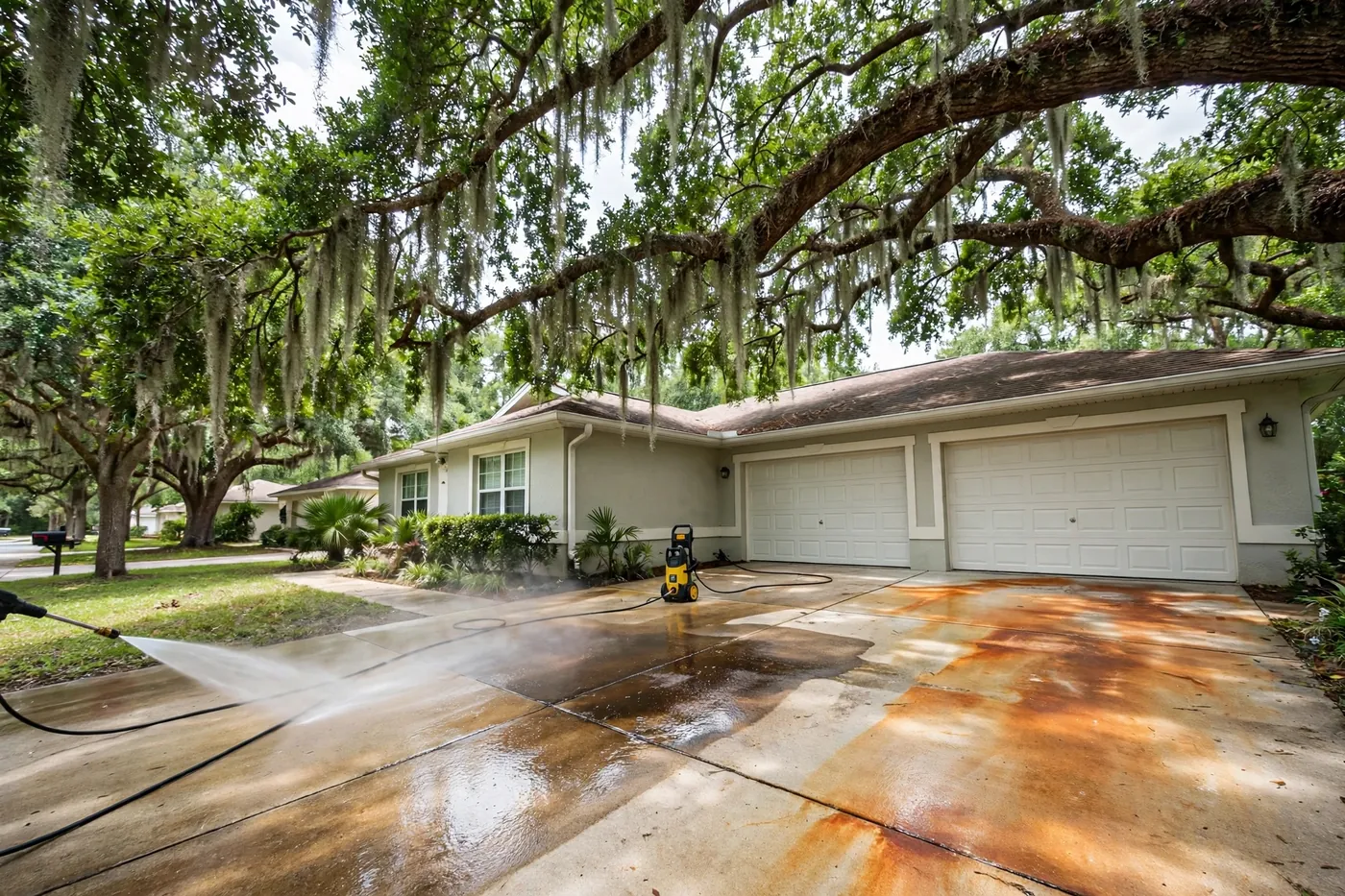
Oak canopy shade plus well-water irrigation equals tannin and rust. The Fleming Island exterior guide.
 BEFOREAFTER
Drag to compare
BEFOREAFTER
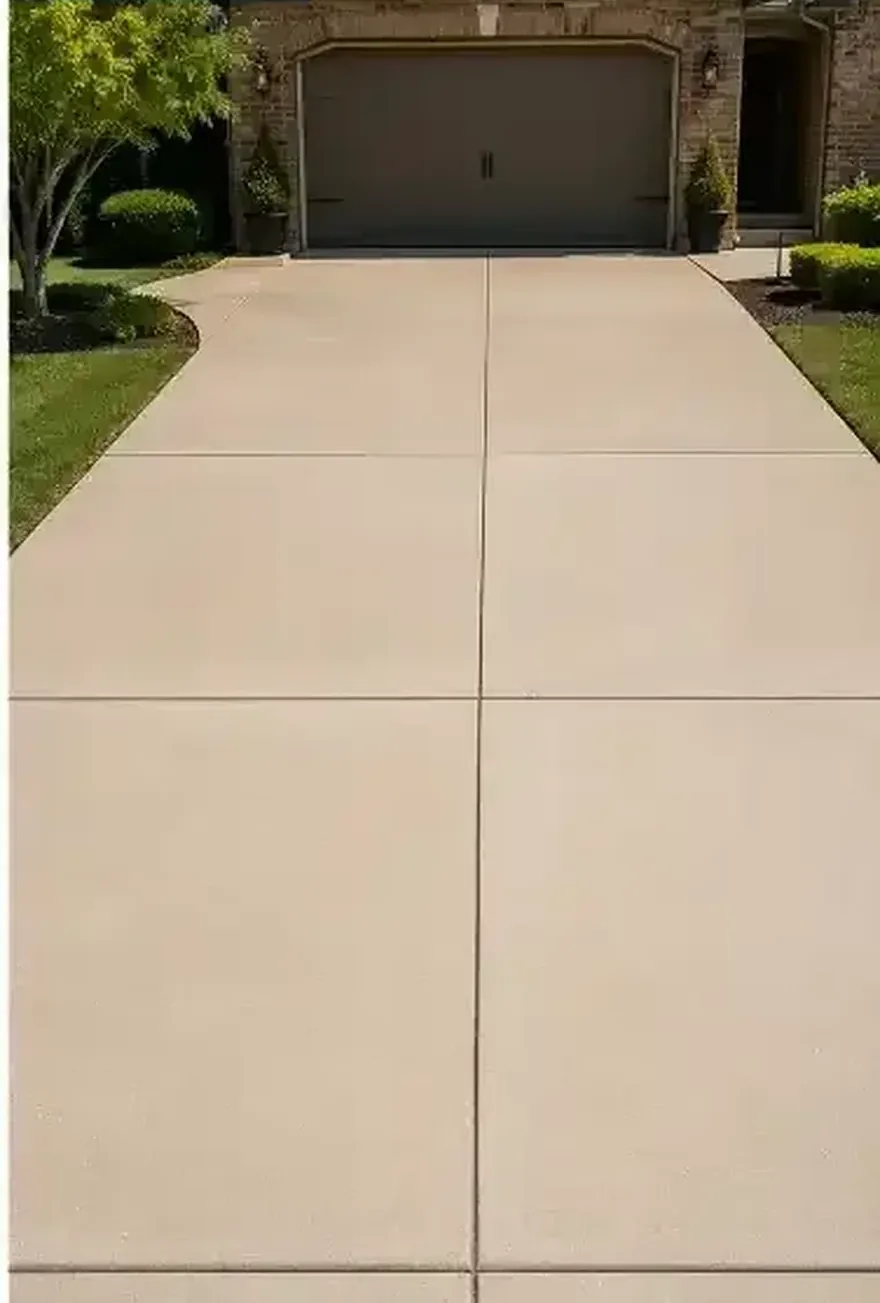
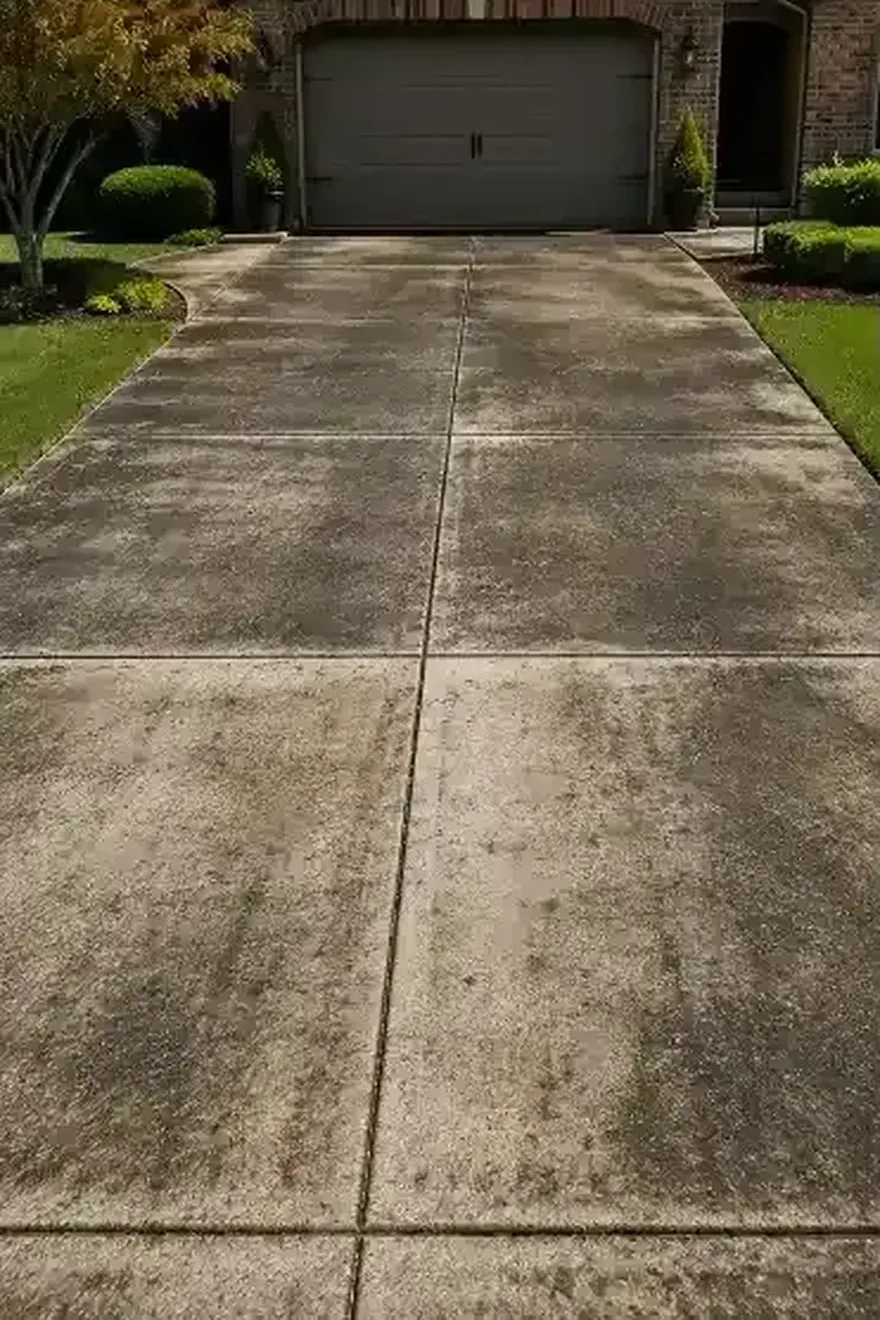
Drag to compareIf your concrete looks like someone spilled pumpkin soup across it, you are looking at iron — and in Fleming Island, the iron usually comes from your own sprinkler system. Large parts of the area, from the neighborhoods along US-17 to the streets backing up to Black Creek and Doctors Lake, run on private wells or reclaimed water with high iron content. Every morning the irrigation mists the driveway edge, the sidewalk, and the lower walls, and the iron oxidizes into those unmistakable orange-brown stains.
People searching for pressure washing Fleming Island FL are often staring at exactly this and assuming the concrete is ruined. It is not. Iron staining is a surface chemical deposit, not structural damage, and it responds very well to the right treatment. But it will not respond to plain water at any pressure — iron oxide laughs at pressure washers. It needs a chemical approach, which is why the DIY attempts usually end in frustration.
The tell that it is irrigation iron and not something else: the staining follows the arc of your sprinkler heads. You will see it heaviest within a few feet of the heads, fading as you move away, often in a neat fan pattern. If that describes your driveway, keep reading — the fix is straightforward.
The second half of Fleming Island's exterior story is written by the live oaks. The canopy here is magnificent — streets where the branches meet overhead — and it creates a perfect storm for exterior staining. Oak leaves and acorns steep tannin into everything below them every time it rains, leaving brown tea-colored stains on driveways, fences, and roofs. The deep shade keeps surfaces damp for days after a storm, and damp plus Florida heat equals algae.
North-facing walls under the canopy are the worst of it. We regularly see siding in Fleming Island that is green from top to bottom on the shaded side while the sunny side looks nearly new. That is not a defect in your siding — it is just biology doing what biology does in a humid subtropical canopy. Soft washing with the right detergents kills it completely, and the difference on a shaded wall is genuinely startling.
Gutters deserve a mention here too. Oak catkins, leaves, and pollen pack gutters solid by late spring, and overflowing gutters sheet dirty water down the siding in stripes. If your siding has vertical streak stains, check the gutters before you blame the siding.
Removing iron stains takes chemistry, not force. We apply a specialized rust-removal treatment that dissolves the iron oxide, let it dwell, then rinse it away — usually at moderate pressure that is completely safe for the concrete. Watching an orange driveway turn back to gray in minutes is one of the more satisfying transformations in this business.
Here is the honest-limits part: very old, very deep iron staining can leave a faint shadow even after treatment, especially on older, more porous concrete that has been absorbing iron for a decade. We will do a test area first and show you exactly what to expect before you commit to the whole driveway. In the large majority of cases, though, the result is dramatic — driveways that looked permanently ruined come back to essentially new.
One thing we will not do is crank up the pressure to compensate. High pressure on a rust stain just etches the concrete around the stain while leaving the iron behind, giving you a permanently scarred driveway that is still orange. Chemistry first, always.
Cleaning the rust is only half the job if the sprinklers keep laying down fresh iron every morning. The permanent fix is at the irrigation system, and you have a few options. A whole-house iron filter on a well system stops the staining at the source — it is an investment, but so is re-cleaning the driveway every year. At minimum, have an irrigation tech adjust head angles and arcs so they are not misting the driveway, sidewalk, and house walls.
Reclaimed water users have fewer options since you cannot filter the utility supply, but redirecting heads still helps enormously. Even moving the spray pattern six inches off the concrete cuts new staining by most of it. And if you are on well water, get the iron level tested — knowing your parts per million tells you whether treatment will be a one-time reset or something to plan around.
We are happy to coordinate timing: get the irrigation adjusted, then call (904) 938-5900 and we will clean up years of staining in a single visit. Doing it in that order means you only pay for the deep clean once.
For a typical Fleming Island home under the oaks, every twelve to eighteen months keeps exteriors looking sharp. If you are on well water with high iron, consider having the driveway treated on its own cycle — sometimes annually — while the house siding goes longer. And the single best time of year here is late spring, after the oaks finish dropping catkins and pollen but before hurricane season's daily rains.
Professor Pressure Washing has been family-owned in Jacksonville since 2015, and well-water rust plus oak tannin is a combination we know cold. Call (904) 938-5900 and we will start with a test spot on your worst stain — you will see the result before you spend a dollar on the full job.
Almost certainly iron from irrigation water. Much of Fleming Island runs on wells or reclaimed water with high iron content, and daily sprinkler misting oxidizes into orange-brown stains in a fan pattern following your sprinkler arcs. It is a surface deposit, not concrete damage, and it cleans off with the right treatment.
Yes — anywhere the mist lands regularly: lower siding, brick, fences, and pool decks. The same iron that stains the driveway stains everything else in the spray pattern. Adjusting head angles away from the house is the cheapest prevention there is.
With chemistry, not pressure. We apply a rust-dissolving treatment, let it dwell, and rinse at moderate pressure. High pressure would etch the concrete while leaving the iron behind, so we never go that route. A test spot first shows you exactly what to expect.
San Marco's 1920s–40s Mediterranean Revival homes need a gentle touch. Here's how to clean brick, stucco and historic wood without damage.
Read More →Ortega's riverfront estates face salt air, river humidity and dock grime. A complete guide to waterfront exterior cleaning.
Read More →Springfield's century-old homes need soft washing, not brute force. How to restore historic siding safely.
Read More →Call now for a free estimate and same-day service in Jacksonville, FL. Open 24/7.
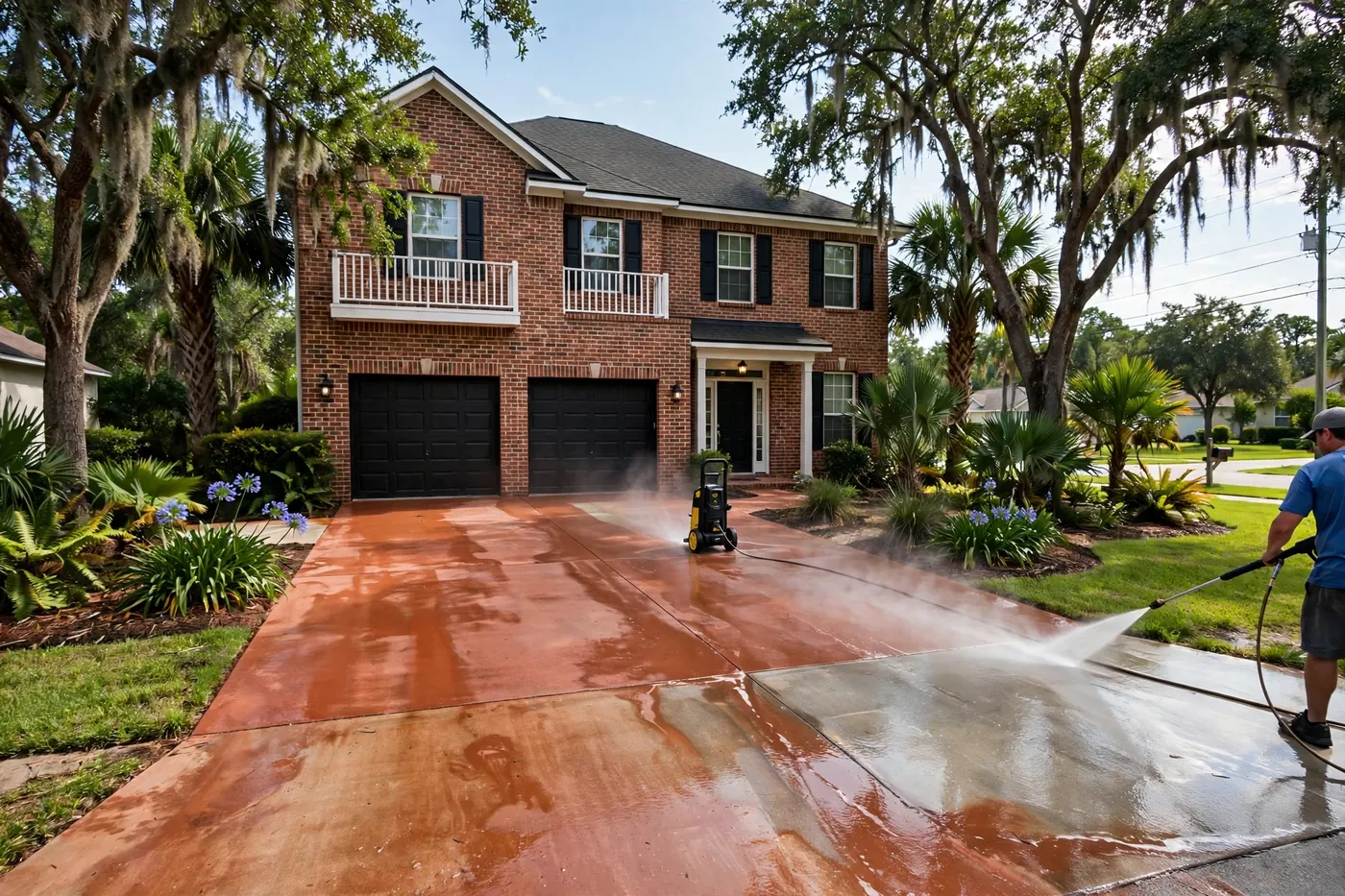
St. Johns County's booming suburbs: red dirt, new HOAs and first-wash timelines for new homeowners.
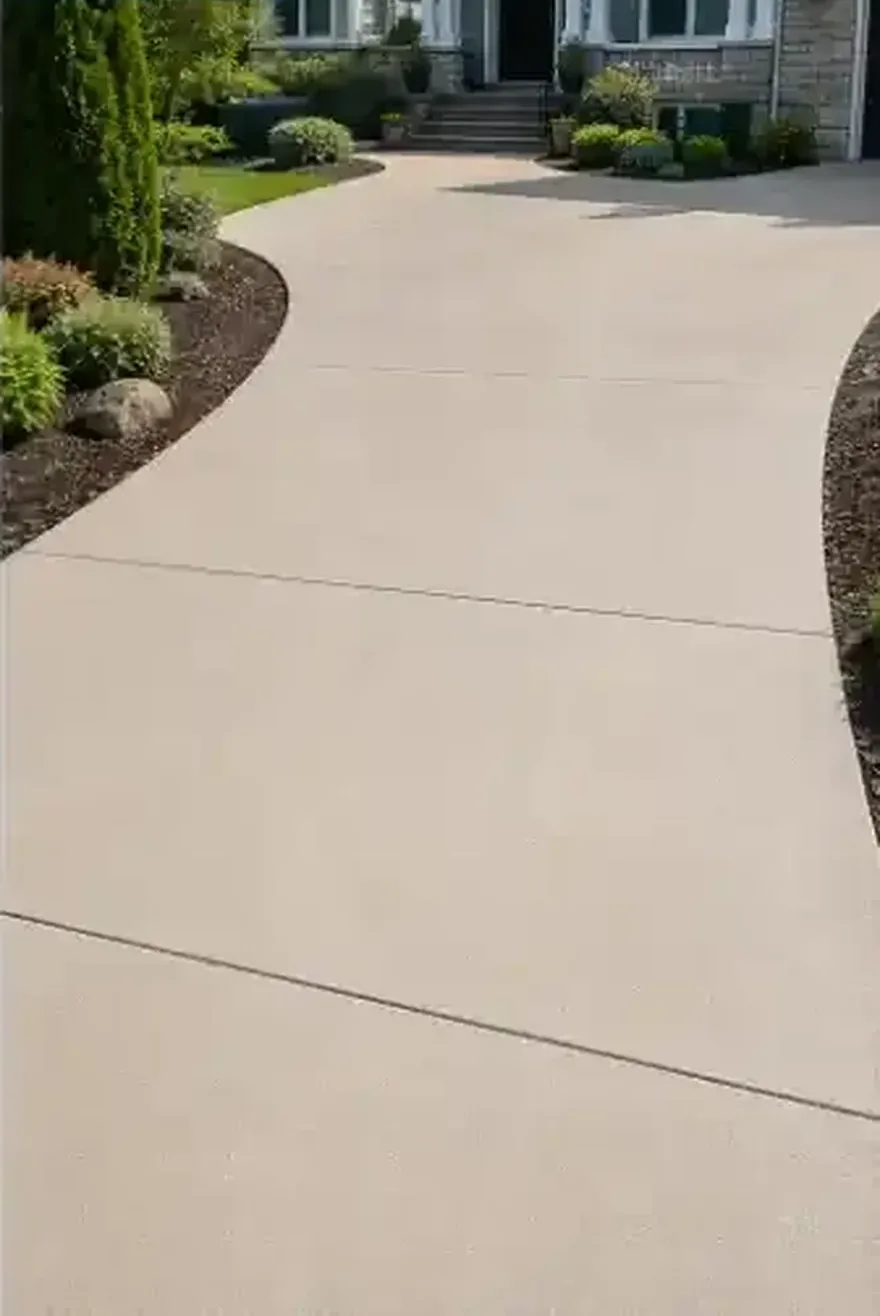
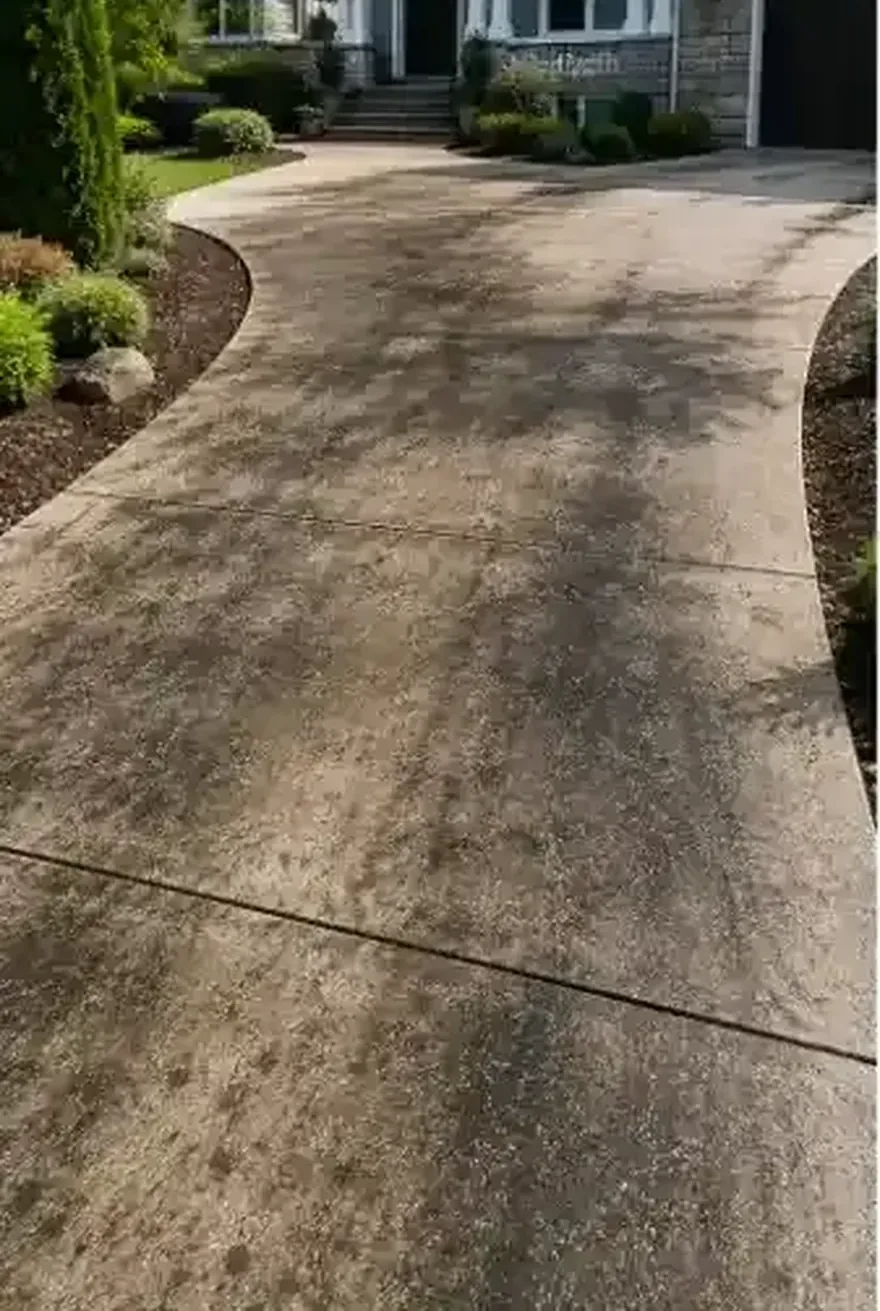 BEFOREAFTER
Drag to compare
BEFOREAFTER
Drag to compareAnyone who has lived through a building boom along Racetrack Road or State Road 13 knows the color: that unmistakable rust-red film that coats driveways, sidewalks, garage doors, and even the lower courses of brick during construction season. Julington Creek and the Durbin area sit on iron-rich clay soil, and when land is cleared for the next phase of subdivisions like Aberdeen, Durbin Crossing, or Julington Creek Plantation, that red dirt goes airborne and settles on everything within a half mile.
Red clay stains look alarming but they are one of the more satisfying things we remove. The iron oxide bonds to concrete and paint, so a plain rinse will not touch it, but the right detergents break that bond and lift the color out. If your home backed up to an active construction zone, you may need two passes — the first gets the bulk, the second catches what bled back out of the concrete pores as it dried. When people search for pressure washing Julington Creek, red clay removal is behind a large share of those calls.
One honest note: red clay tracked by car tires can re-stain a driveway surprisingly fast if construction is still active next door. We will tell you straight if waiting until the bulldozers leave makes more sense than washing twice.
The master-planned communities here — from the older sections of Julington Creek Plantation to the newest Durbin parcels — run on HOA standards, and exterior appearance is near the top of every enforcement list. Mildew on siding, stained driveways, and green fences draw compliance letters, and those letters always seem to arrive right before a holiday weekend.
Here is what surprises new homeowners: the HOA generally cares about the result, not who does the work, but the work has to meet a standard. A streaky DIY wash that leaves wand marks can actually look worse to an inspector than the mildew did. Professional equipment — surface cleaners for flatwork, soft wash for siding — produces the uniform, even finish that HOAs want to see. We photograph before and after on every HOA-related job so you have documentation if anyone asks questions later.
If you bought new construction in the last year or two, your home is probably dirtier than it looks. Builder-grade cleanup leaves a film of construction dust on everything, stucco has efflorescence ghosting from curing, and the sod crew's irrigation has been misting your lower walls daily. Most new Julington Creek homes benefit enormously from their first real wash at around the one-year mark.
There is also a practical reason not to wait too long: that first year is when you establish the baseline. Algae has not yet rooted deeply into shaded siding, irrigation rust has not yet etched into concrete, and the whole job goes faster and costs less than it will at year three. Think of it like the first detailing on a new car — early care pays off for years.
After that first wash, the rhythm here is typically every twelve to twenty-four months depending on shade, irrigation habits, and how close you are to the next construction phase.
A proper Julington Creek exterior wash is a whole-property job, not just the siding. The house itself gets soft washed — stucco, brick, and vinyl all take different detergent mixes. Driveways and walkways get the surface cleaner treatment for that even, like-new finish. Then the details that HOAs actually notice: the sidewalk along the street, the curb, the fence lines, and the lanai or pool deck out back.
Pool decks deserve a special mention because so many homes here have them. Chlorinated splash-out, sunscreen residue, and algae in the textured surface make decks slippery and dull. We wash them at pressures safe for the finish and can advise on sealing afterward, which is the single best thing you can do for a paver or concrete deck in St. Johns County's sun.
You can stretch the time between professional washes with a few habits. Aim irrigation heads away from the house and fence — daily misting is the number one cause of premature staining here. Trim shrubs back six inches from siding so air circulates and walls dry after rain. And after oak pollen season in spring, a simple garden-hose rinse of the porch and entry takes the yellow film off before it bakes in.
When it is time for the real thing, Professor Pressure Washing has served the greater Jacksonville area since 2015 as a family-owned company, and the Julington Creek side of the county is familiar territory for us. Call (904) 938-5900 for a straightforward quote — we will tell you exactly what your property needs and what it does not.
Iron-rich red clay soil, which is everywhere in the Julington Creek and Durbin area. Construction activity sends it airborne, it settles on concrete and paint, and the iron oxide bonds to the surface. Specialized detergents break that bond — a plain water rinse will not remove it.
Most HOAs here require homes to be kept free of visible mildew, staining, and discoloration, and they enforce it with compliance letters. A professional wash produces the uniform finish inspectors expect, and we document before-and-after photos for your records.
Around the one-year mark is ideal for new construction. Builder dust, stucco curing residue, and irrigation overspray accumulate fast in the first year, and an early wash establishes a clean baseline that makes every future wash easier and cheaper.
San Marco's 1920s–40s Mediterranean Revival homes need a gentle touch. Here's how to clean brick, stucco and historic wood without damage.
Read More →Ortega's riverfront estates face salt air, river humidity and dock grime. A complete guide to waterfront exterior cleaning.
Read More →Springfield's century-old homes need soft washing, not brute force. How to restore historic siding safely.
Read More →Call now for a free estimate and same-day service in Jacksonville, FL. Open 24/7.
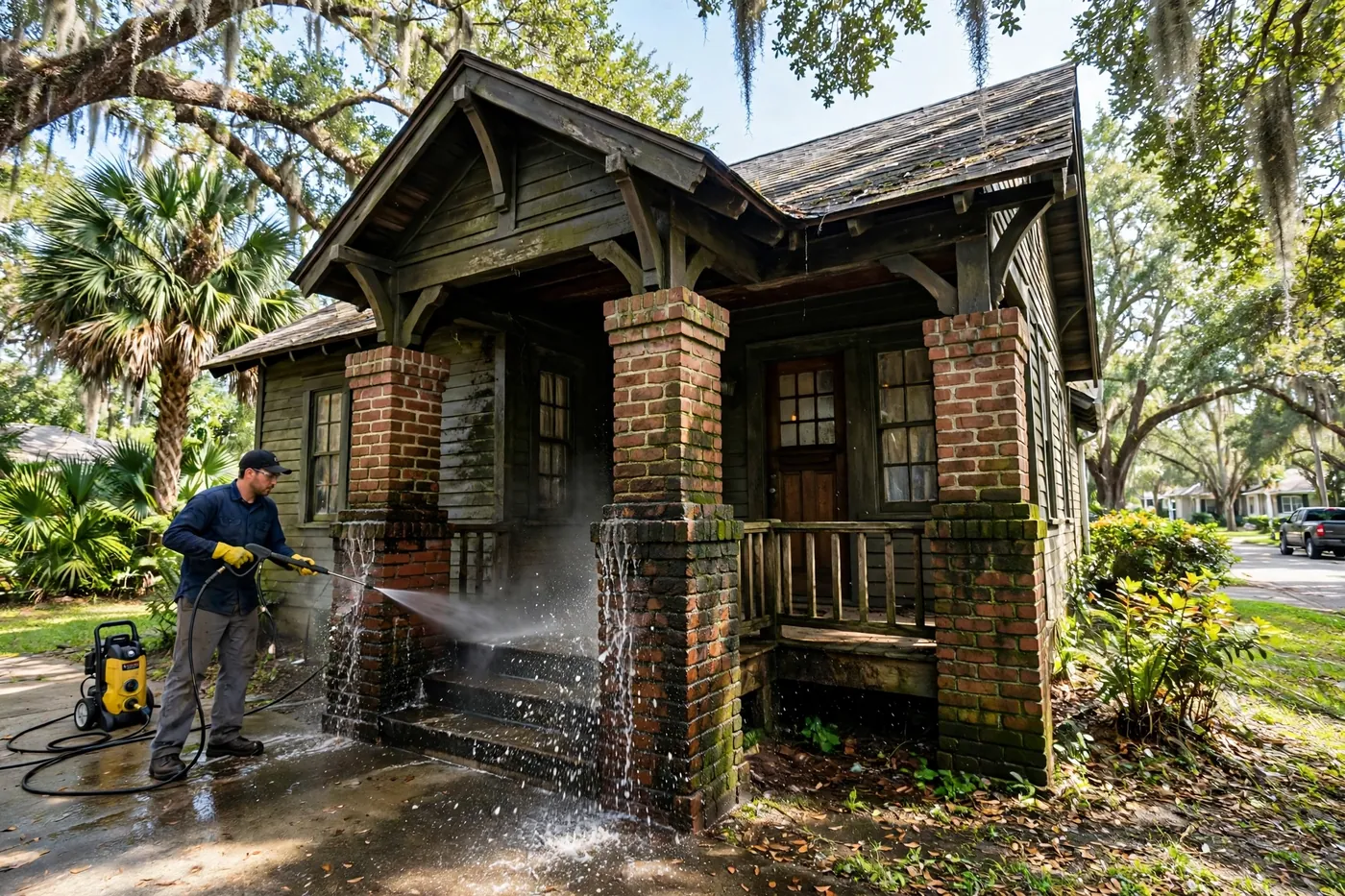
Murray Hill's craftsman bungalows and Edgewood Avenue shops need period-appropriate exterior care.
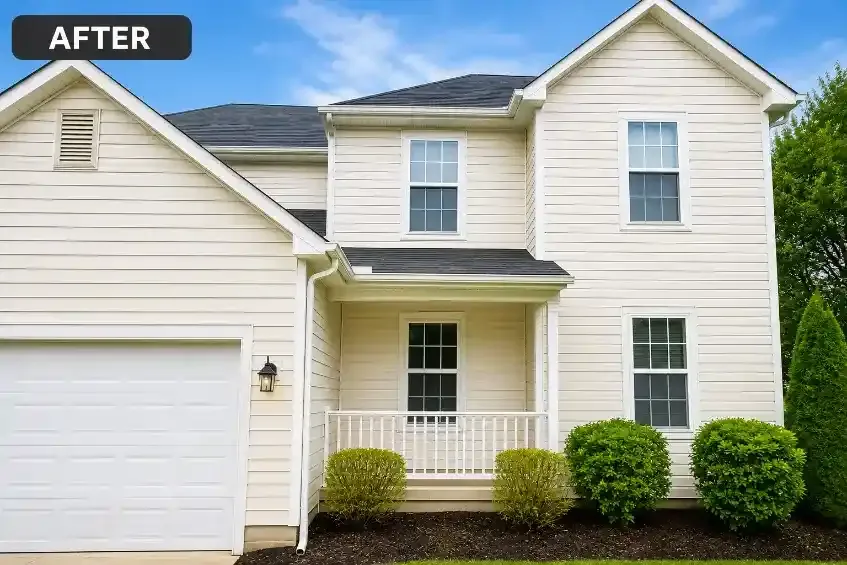
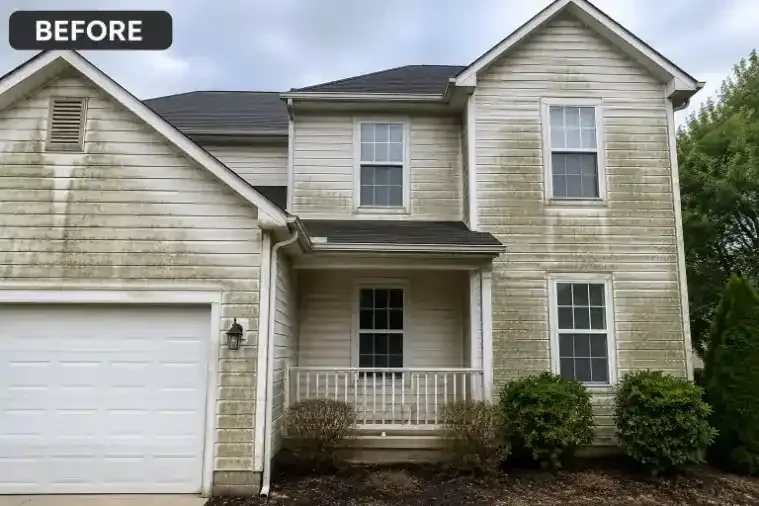 BEFOREAFTER
Drag to compare
BEFOREAFTER
Drag to compareDrive the grid streets off Edgewood Avenue in Murray Hill and you are looking at one of Jacksonville's best collections of craftsman bungalows, most built between the 1920s and 1940s. Deep front porches on brick piers, original wood clapboard, exposed rafter tails, and concrete steps poured when Calvin Coolidge was president. When someone searches for pressure washing Murray Hill Jacksonville, they are usually looking at one of these century-old homes and wondering how to clean it without damaging it.
These houses do not age the way a vinyl-sided subdivision home does. A hundred Florida summers write themselves onto old wood in specific ways: mildew blooming on north-facing clapboard that never sees direct sun, green algae thriving under deep porch eaves, chalky oxidation on decades-old paint, and black streaks where gutters overflow onto the siding. The mature oak canopy that makes streets like Hamilton and Day Avenue so beautiful also keeps everything damp and shaded, which is exactly what mildew loves.
The good news is that almost all of this is surface-level and completely reversible with the right method. The bad news is that the wrong method — a rented machine at full blast in inexperienced hands — can scar old wood, force water behind siding, and strip paint in sheets. Murray Hill homes reward a gentle, knowledgeable approach, and they punish a careless one.
For bungalow wood siding we use soft washing, which is essentially the opposite of what most people picture when they hear pressure washing. Instead of blasting at thousands of PSI, we apply cleaning detergents at roughly garden-hose pressure, let them dwell and do the killing and loosening work, then rinse gently. The detergents kill mildew and algae down to the root so they do not grow back in six weeks, which is what happens with a plain water blast.
Before we touch a full wall we always do a test spot in an inconspicuous area, because old paint and old wood vary wildly even on the same house. We are also honest about what washing cannot fix. If paint is already peeling, alligatoring, or chalking badly, washing will take the loose stuff with it — that is the paint failing, not the wash damaging it. And soft, punky, rotted boards need a carpenter, not a pressure washer. We would rather tell you to paint first and call us after than take your money for a wash that disappoints.
Murray Hill is not just bungalows. The Edgewood Avenue commercial strip — the cafes, vintage shops, breweries, and salons between the railroad tracks and Roosevelt — lives or dies on curb appeal. Foot traffic judges a business by its sidewalk, windows, and facade before it ever reads the menu. Gum spots, grease film near restaurant doors, and grimy awnings quietly tell customers to keep walking.
Storefront work is a different discipline from residential. We schedule it early in the morning before you open, work in sections so customers can still get through the door, and we are gone before the lunch crowd. A typical Edgewood Avenue job covers the sidewalk out front, the facade and windowsills, and any awnings or signage surrounds. Most shops see the difference the same day in how the block feels — and regulars notice when the corner looks cared for.
Behind and beside those bungalows sits some of the oldest residential concrete in Jacksonville: original driveways, ribbon driveways, and sidewalk panels poured eighty or ninety years ago. Decades of oak leaves leave tannin stains that look like tea spilled across the concrete. Shaded sections grow a slick layer of algae that is genuinely slippery when wet. And every Murray Hill driveway has its archaeology of oil drips.
We clean old concrete with a rotary surface cleaner, which keeps the pressure even and avoids the zebra-striping you get from wanding back and forth. Tannin and algae come off beautifully. Old oil is the honest-limitation conversation: fresh drips usually lift, but stains that have been baking into concrete since the 1970s will lighten dramatically without fully disappearing. We will tell you which yours is before we start, not after.
For a Murray Hill bungalow under the oak canopy, plan on a professional wash every twelve to eighteen months. Heavily shaded lots, or homes near the drainage ditches that stay damp, trend toward the shorter end. Spring is the sweet spot — right after oak pollen season coats everything in yellow-green film, and before the summer thunderstorm pattern keeps surfaces wet for months.
Professor Pressure Washing has been family-owned and serving Jacksonville since 2015, and historic neighborhoods are some of our favorite work because the transformations are so dramatic. If you are unsure whether your siding needs washing or painting first, call (904) 938-5900 and we will give you a straight answer — including telling you when washing is not what you need.
We soft wash it: low-pressure application of detergents that kill mildew and algae, a dwell period, then a gentle rinse. No high pressure ever touches old wood, and we test an inconspicuous spot first. If the paint is already failing, we will tell you to paint before washing.
We handle those too, scheduled early morning before opening so there is no disruption. Sidewalks, facades, windowsills, and awnings are the usual scope, and most jobs are done before the lunch crowd arrives.
Every twelve to eighteen months is the right rhythm for most bungalows here. Heavily shaded lots or homes near damp drainage areas may need it closer to annually, and spring after pollen season is the ideal time.
San Marco's 1920s–40s Mediterranean Revival homes need a gentle touch. Here's how to clean brick, stucco and historic wood without damage.
Read More →Ortega's riverfront estates face salt air, river humidity and dock grime. A complete guide to waterfront exterior cleaning.
Read More →Springfield's century-old homes need soft washing, not brute force. How to restore historic siding safely.
Read More →Call now for a free estimate and same-day service in Jacksonville, FL. Open 24/7.
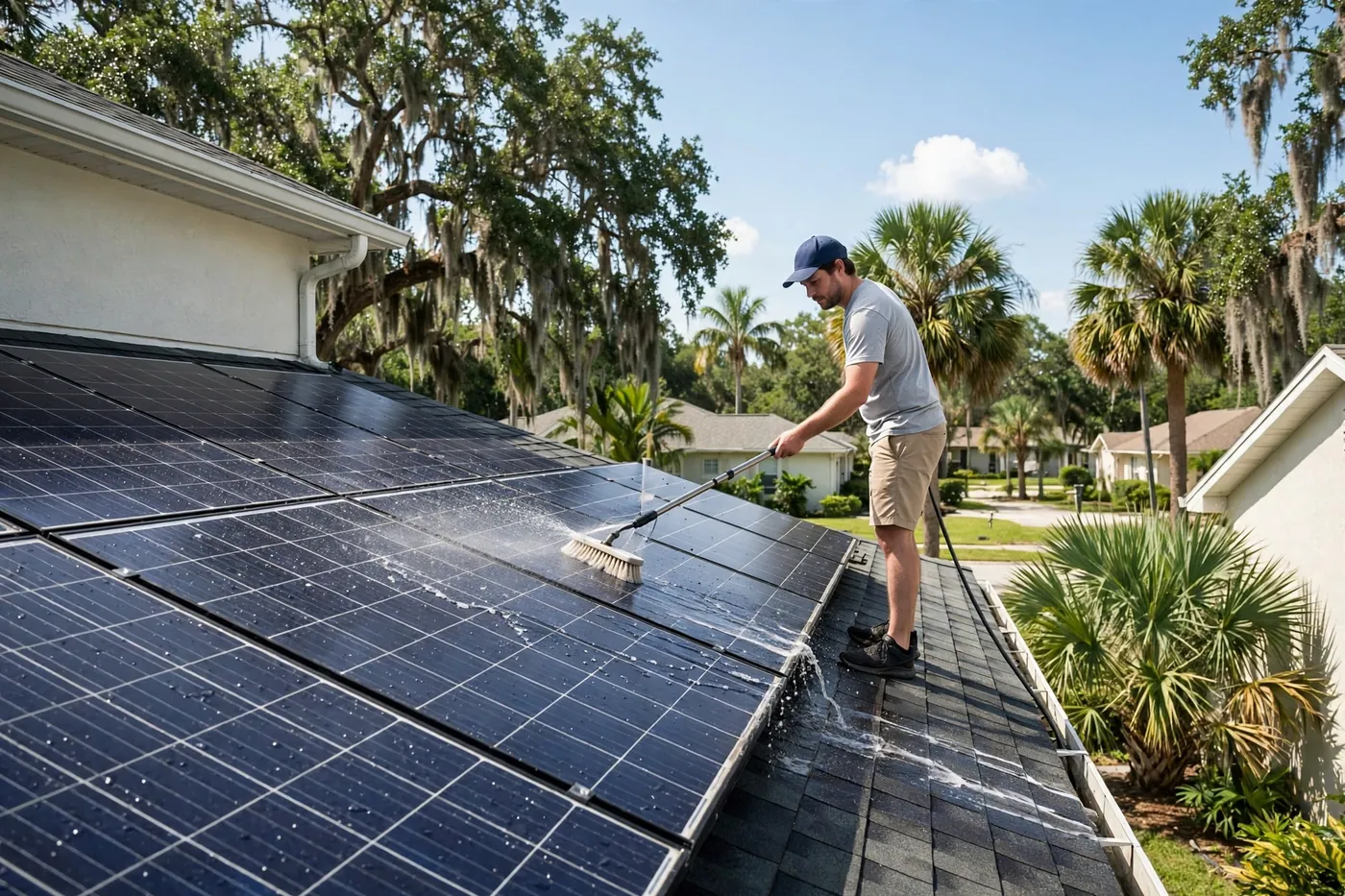
Oak pollen and salt film can cut panel output significantly. Safe cleaning restores production.
BEFOREAFTER
Drag to compareEvery March through May, Jacksonville disappears under a yellow-green blanket of oak pollen — the live oaks of Mandarin, Ortega, and San Marco are magnificent and merciless. That same pollen settles on rooftop solar arrays in a sticky film that does not rinse off in rain; in fact, spring showers bake it into a stubborn haze. Add the salt film that drifts inland from the Atlantic year-round, and Jacksonville panels carry a soiling load most solar installers never warned you about.
The efficiency cost is real and well-documented. Industry studies consistently show soiled panels losing anywhere from 5 percent to 25 percent of output depending on soiling severity, with pollen-heavy regions like ours sitting uncomfortably high in that range. On a typical Jacksonville residential array, a 15 percent soiling loss can mean hundreds of dollars a year in foregone production — silently, month after month, while the panels look 'fine' from the ground.
Most owners never connect the dots because the loss is gradual. Your monitoring app shows a slow decline you attribute to weather or seasons. Then someone cleans the panels and production jumps 10 to 20 percent overnight. We see that reveal regularly, and it is the single best argument for treating panel cleaning as maintenance, not vanity.
Solar cells are wired in series, which means the dirtiest cell limits the whole string — a concept installers call the 'Christmas light effect.' A pollen-caked lower edge or a bird-dropping hotspot does not just reduce that spot's output; it drags down every panel wired with it. Partial soiling is disproportionately damaging, which is why the patchy, streaky film Jacksonville roofs develop is worse than uniform dust.
There is also a heat dimension. Dark soiling absorbs heat, and solar panels lose efficiency as they get hotter — roughly half a percent per degree above standard test conditions. A grimy panel in a Jacksonville July is running hotter than a clean one, compounding the optical loss with thermal loss. It is a double penalty unique to dirty panels in hot climates.
Long-term, neglected soiling causes its own damage. Organic matter holds moisture against the glass, encouraging the growth of lichen in shaded array corners — and lichen etches glass microscopically if left for years. Bird droppings are acidic enough to stain anti-reflective coatings. Cleaning is not just about today's kilowatt-hours; it protects a twenty-five-year asset.
Here is the most important thing in this article: never let anyone pressure wash your solar panels. High-pressure water can crack cells, force moisture past seals into the junction box, and void manufacturer warranties that explicitly exclude pressure damage. Panels are also slippery when wet and often near roof edges — the fall risk is real. If a contractor proposes to 'blast' your array, that conversation is over.
Professional panel cleaning is deliberately gentle: deionized or purified water (so it dries spot-free), soft brushes or cloths, and zero abrasives. We work from ladders and roof anchors — never walking on the panels themselves, which can micro-crack cells underfoot — and we clean in the cool of morning or evening, because thermal shock from cold water on hot glass is a genuine cracking risk in Florida.
Detergents are a judgment call. Most manufacturer guidance favors pure water alone; we use it exclusively unless hard-water spotting or stubborn organic growth demands a panel-safe surfactant, and we rinse completely either way. The goal is glass so clean it disappears — maximum light transmission, zero residue, zero risk to the array.
For most Jacksonville homes, the honest answer is two to four times per year, anchored to local realities. Cleaning number one comes in late May or June, right after oak pollen season ends — this is the highest-value wash of the year, restoring the output pollen stole all spring. Cleaning number two lands in fall, after hurricane season's wind-driven grime and before the lower winter sun angle makes every percentage point count.
Homes near the beaches — Jacksonville Beach, Neptune Beach, Ponte Vedra — should lean toward the higher end, because salt film accumulates continuously and does not wait for pollen season. Homes under heavy oak canopy in Ortega or Avondale get the pollen worst and may want a mid-spring touch-up in heavy years. Arrays near construction, like the growth corridors of Nocatee and eTown, collect dust that justifies an extra pass.
Your monitoring app is the ultimate guide: if production drops 5 percent or more from its clean baseline in similar weather, the panels are telling you they are dirty. We are happy to do a first cleaning and help you establish that baseline — then the data makes the schedule obvious.
Run the numbers honestly. A typical Jacksonville residential array (say, 8 kilowatts) in good sun produces roughly 11,000 to 12,000 kilowatt-hours per year. At JEA's residential rates, a 10 percent soiling loss — conservative for a pollen-season array — costs on the order of $130 to $170 annually in lost production. Two professional cleanings per year cost less than that recovered value for most homes, before counting the protection against long-term glass and coating damage.
The math improves for larger arrays and for homes on time-of-use or high-tier rates, and it is most compelling right after pollen season, when a single cleaning can restore the year's biggest loss in one visit. What does not pencil out is DIY: the purified water, proper brushes, roof safety equipment, and your Saturday are worth more than the service call — and the warranty risk of a misstep is entirely yours.
Professor Pressure Washing is family-owned and has served Jacksonville since 2015. If your monitoring app has been drifting downward, or pollen season just ended, call (904) 938-5900. We will clean your array the safe way — no pressure, no walking on panels, no residue — and let your production numbers tell the rest of the story.
Documented soiling losses range from about 5 percent for light dust to 25 percent for heavy organic soiling, with pollen-heavy regions like Jacksonville commonly seeing 10 to 20 percent during and after oak pollen season. Because cells are wired in series, even patchy soiling drags down whole strings. Most owners are surprised how much a single cleaning restores — the monitoring app usually tells the story within days.
We never walk on the panels themselves — foot traffic can micro-crack solar cells, and most manufacturers exclude such damage from warranty. We work from ladders and proper roof anchors, clean in the cool of morning or evening to avoid thermal shock to hot glass, and use only soft brushes with purified water. If roof access is unsafe, we will tell you that honestly rather than improvise.
Two to four times per year for most Jacksonville homes: once right after oak pollen season ends (late May/June), once after hurricane season in fall, with extra passes for beach-area homes dealing with year-round salt film or homes under heavy oak canopy. Your monitoring app is the best guide — a 5 percent-plus drop from baseline in similar weather means it is time.
San Marco's 1920s–40s Mediterranean Revival homes need a gentle touch. Here's how to clean brick, stucco and historic wood without damage.
Read More →Ortega's riverfront estates face salt air, river humidity and dock grime. A complete guide to waterfront exterior cleaning.
Read More →Springfield's century-old homes need soft washing, not brute force. How to restore historic siding safely.
Read More →Call now for a free estimate and same-day service in Jacksonville, FL. Open 24/7.
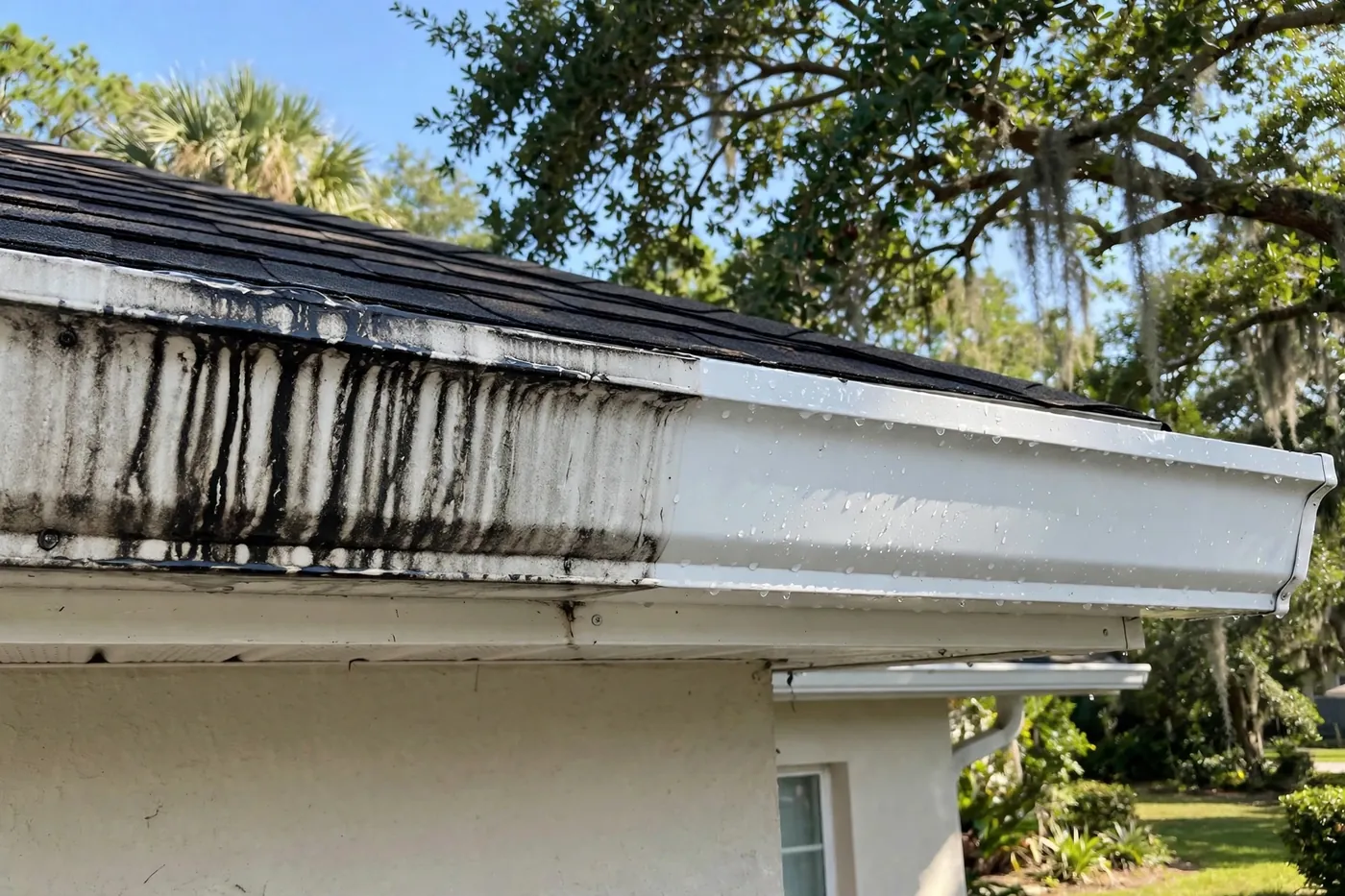
Those black streaks on white gutters are oxidation — and brightening makes them look new again.
BEFOREAFTER
Drag to compareIf your Jacksonville home has white or light-colored gutters, you know the look: vertical black streaks striping down the face of every gutter run, like the world's saddest tiger. It shows up fastest on the street-facing side, usually within a year or two of installation or painting, and it makes otherwise clean siding look neglected by association. In neighborhoods from Mandarin to Nocatee to the beaches, tiger striping is practically a regional signature.
The streaks are not dirt in the normal sense, which is why they survive rainstorms, garden hoses, and even standard pressure washing. They are a combination of oxidized aluminum, electrostatic bonding of airborne pollutants, and the drip lines where water sheets off the roof edge carrying shingle granule residue and tannins. Jacksonville's humidity accelerates the oxidation; the oak pollen season adds a sticky film that traps everything against the metal.
Here is the key insight most homeowners miss: tiger striping is a chemical problem, not a pressure problem. Blasting it with high pressure is like trying to sand off a stain — you can damage the gutter's finish long before the streaks surrender. The fix is chemistry, applied by hand, which is exactly what gutter brightening is.
This surprises people, because pressure washing fixes nearly everything else on a home's exterior. But tiger striping is oxidation bonded to the aluminum at a molecular level, layered with electrostatically attracted pollutants. Water pressure — even the 3,000-plus PSI of a commercial machine — slides right over it. We have watched homeowners rent machines and carve clean stripes into their siding trying; the streaks stay, and the gutter finish suffers.
Worse, aggressive pressure on gutters causes real damage: it can dent aluminum, force water behind the gutter into the fascia, and strip the factory finish, which actually makes future striping worse by exposing raw, reactive metal. If a contractor proposes to 'just hit the gutters with the pressure washer' as part of a house wash, that is a sign to keep looking.
The honest version: a house wash will make your siding, soffits, and fascia look new, and it will remove the loose dirt from gutters — but the tiger stripes will still be there when it dries. Brightening is a separate, dedicated service, and any honest company will tell you that upfront rather than let you discover it afterward.
Gutter brightening is a hand process, not a spray-and-pray. We apply a specialty brightening solution — formulated specifically for oxidized aluminum — to the gutter faces with applicators, working in sections so the product dwells long enough to break the oxidation bond without drying on the surface. Jacksonville's heat makes this timing critical; in July we work smaller sections and often start on the shaded side.
After the dwell, each section is gently agitated and rinsed — low pressure, controlled, with the rinse directed so nothing splashes onto freshly cleaned siding below. Downspouts get the same treatment, since they stripe just like the runs. The whole process is done from ladders with standoffs that protect the gutters we are trying to save; no one should be leaning a ladder directly on the gutter face.
The result is genuinely dramatic: white gutters return to factory white, and the home's entire roofline looks new. On most Jacksonville homes the visible transformation rivals a full house wash, because the gutters frame every view of the house. Before-and-after photos of brightening are some of our most satisfying — the stripes simply vanish.
Homeowners often ask whether they should just replace striped gutters. The math usually favors brightening by a wide margin: professional brightening typically costs a fraction of full gutter replacement, takes hours instead of days, and leaves you with gutters that look new. Replacement makes sense only when the gutters themselves are failing — sagging runs, separated seams, chronic overflow from undersized systems, or widespread corrosion.
There is a middle case worth naming: gutters with failing paint. Brightening restores the aluminum's appearance, but it cannot fix peeling or flaking paint — that needs repainting or replacement. During our estimate we will tell you which category yours fall into; we have talked homeowners out of brightening when paint failure meant it would not last, because a service that does not hold is not a service worth selling.
One more honest note: seamless aluminum gutters, the standard on most Jacksonville homes built in the last thirty years, brighten beautifully. Older steel gutters with active rust are a different story — brightening improves them, but rust bleed will return. We will show you the difference on your own gutters before you decide.
In Jacksonville's climate, professional gutter brightening typically holds its fresh-white look for one to three years. The range depends on exposure: south- and west-facing runs re-stripe fastest under direct sun and driving rain, while shaded north sides can look new for years. Homes under heavy oak canopy — hello, Ortega and Avondale — get more tannin drip and may sit at the shorter end.
Maintenance washes extend the result significantly. When we soft wash your home's exterior annually, a light brightening touch-up on the gutter faces keeps striping from ever re-establishing — much like dental cleanings prevent the need for deep scaling. Most of our brightening clients fold it into their regular house wash schedule after the first full treatment.
Professor Pressure Washing is family-owned and has served Jacksonville since 2015. If your gutters are wearing tiger stripes, call (904) 938-5900 — we will inspect them honestly, tell you whether brightening or replacement is the right call, and leave your roofline looking new. No pressure-washer roulette, just the right chemistry applied the right way.
Tiger striping is oxidized aluminum combined with electrostatically bonded airborne pollutants and drip-line residue from the roof edge — shingle granules, tannins, and dirt. Jacksonville's humidity accelerates the oxidation, and oak pollen season adds a sticky film that traps it all against the metal. It is a chemical bond, not loose dirt, which is why rain and pressure washing do not remove it.
No — and that distinction matters. Pressure washing uses water force, which cannot break the oxidation bond behind tiger striping and can actually damage gutter finishes. Brightening is a chemical process: specialty aluminum-safe solutions are hand-applied, allowed to dwell, agitated, and gently rinsed. It is closer to detailing than to washing.
Typically one to three years in Jacksonville, depending on sun exposure and tree cover — south- and west-facing runs re-stripe fastest. Annual house washes with a light brightening touch-up keep gutters looking new indefinitely. We will give you an honest expectation for your specific home during the free estimate.
San Marco's 1920s–40s Mediterranean Revival homes need a gentle touch. Here's how to clean brick, stucco and historic wood without damage.
Read More →Ortega's riverfront estates face salt air, river humidity and dock grime. A complete guide to waterfront exterior cleaning.
Read More →Springfield's century-old homes need soft washing, not brute force. How to restore historic siding safely.
Read More →Call now for a free estimate and same-day service in Jacksonville, FL. Open 24/7.
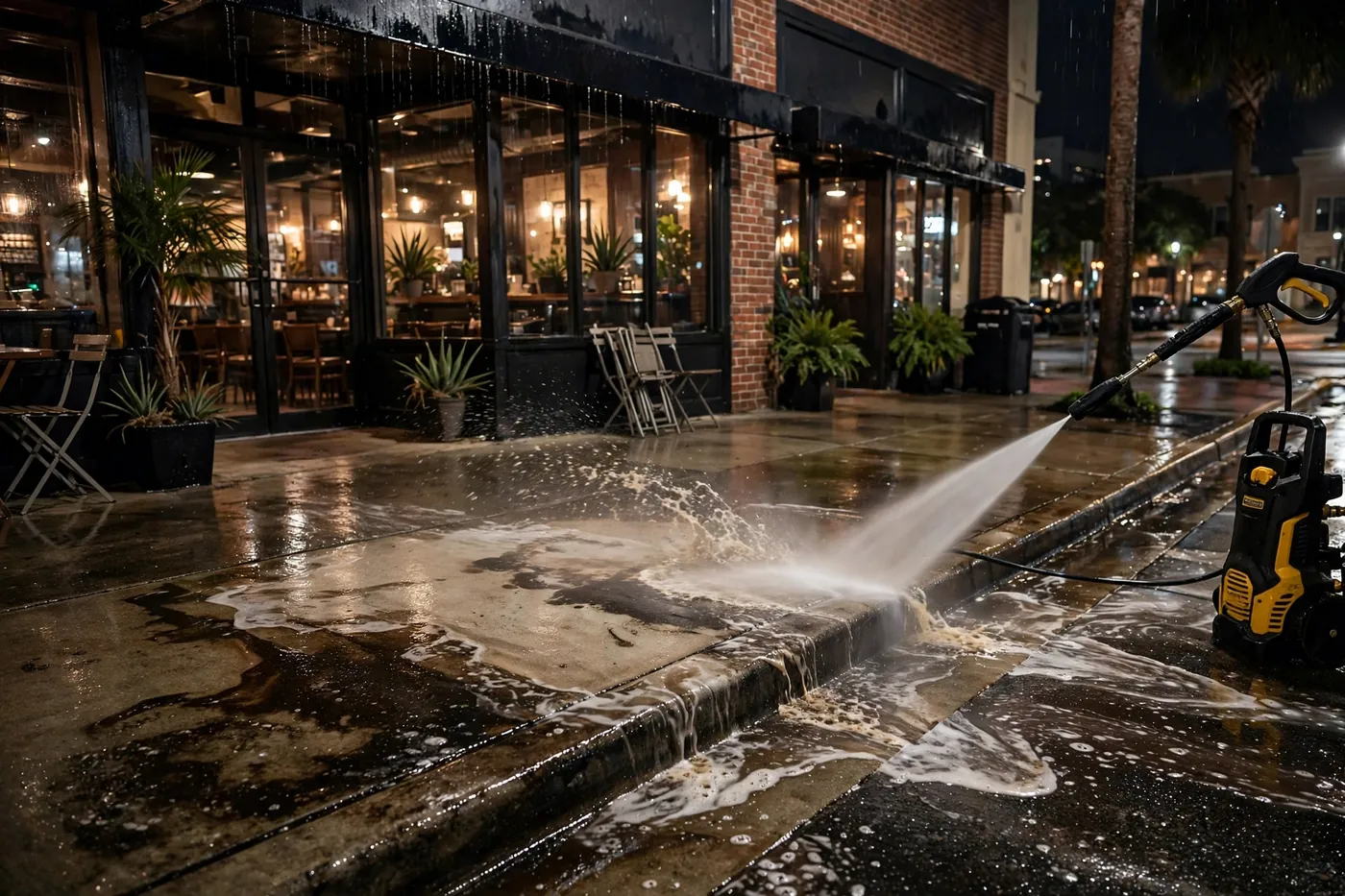
Health inspectors look past the dumpster pad. Sidewalks, drive-thrus and entries done right.
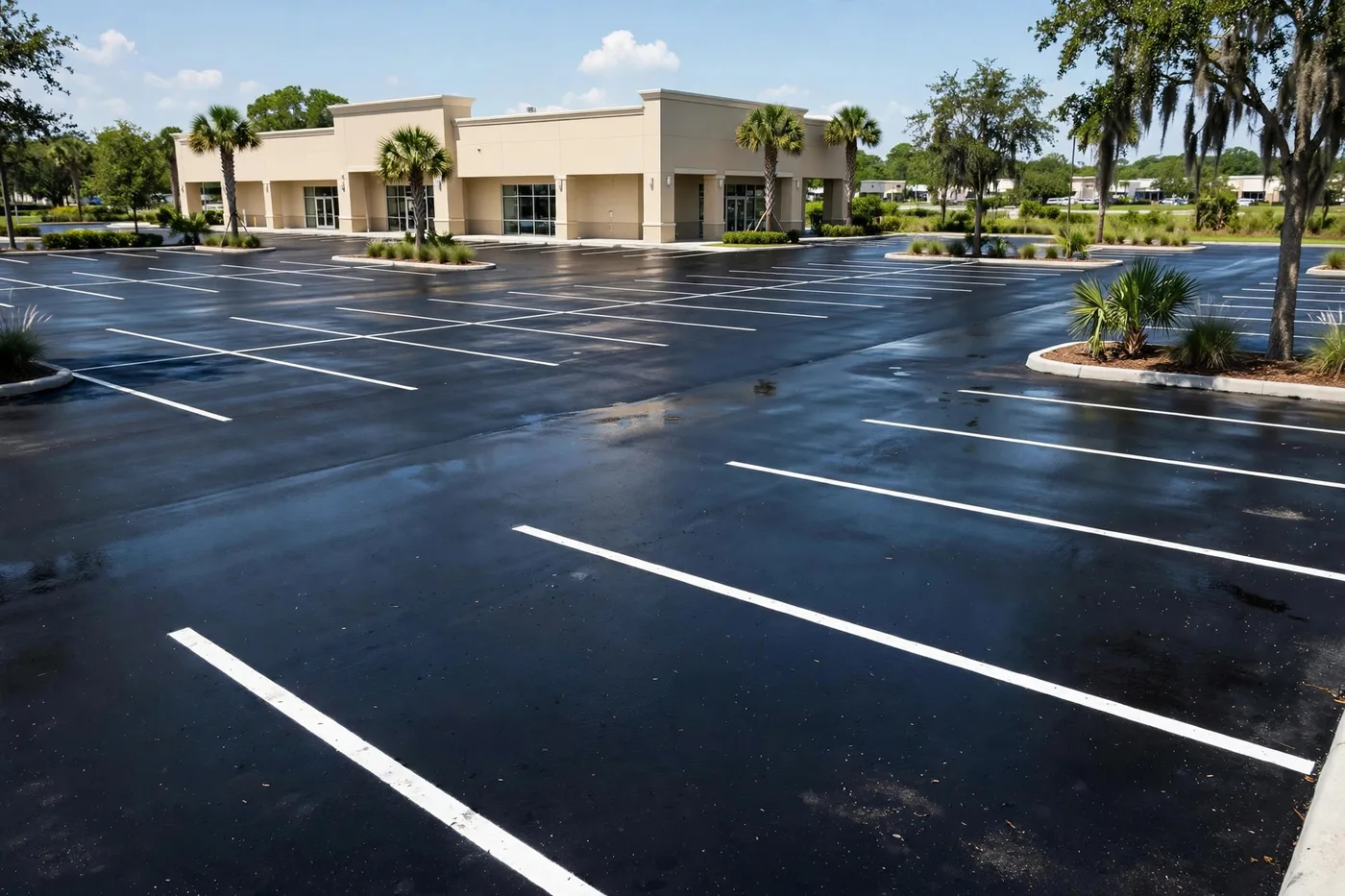
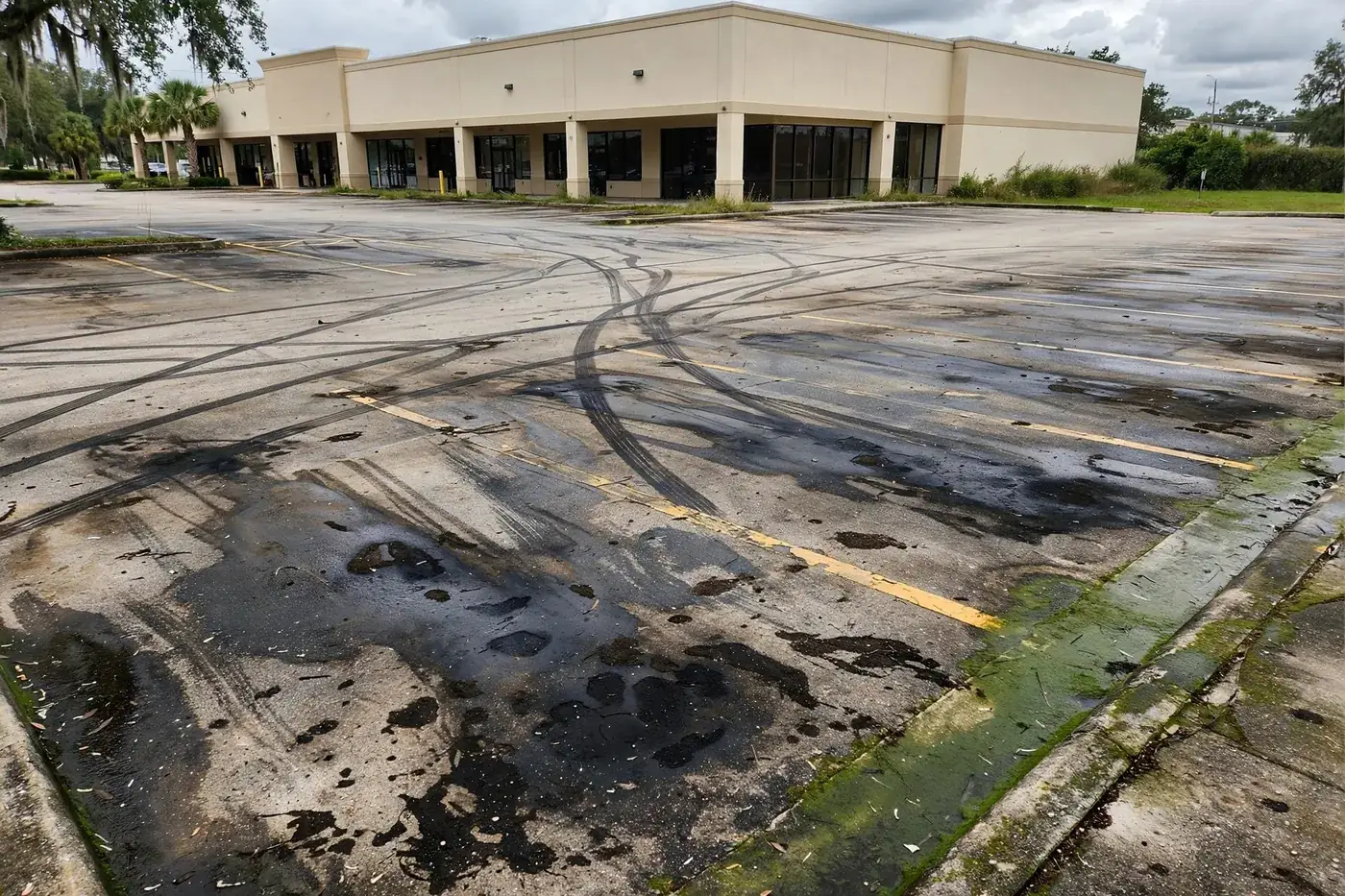 BEFOREAFTER
Drag to compare
BEFOREAFTER
Drag to compareJacksonville's restaurant scene — from the craft kitchens of Riverside and San Marco to the chains around the Town Center and the seafood houses at the beaches — lives and dies on reputation, and health inspectors do not stop at the kitchen door. The Florida Department of Business and Professional Regulation evaluates the whole premises, and the exterior tells its own story: grease-tracked sidewalks, a rancid dumpster pad, and a drive-thru lane black with oil suggest a kitchen with the same standards.
Guests are inspectors too, and they are less forgiving. The walk from the car to the host stand crosses the dirtiest square footage most restaurants own — entry sidewalks collect grease tracked on shoes, drink spills, and gum at an astonishing rate, all of it baked in by Jacksonville's heat. Outdoor patios, now a permanent fixture of Jax dining, put diners elbow-to-elbow with the property's condition. A stained patio does not just look bad; it makes people wonder about the kitchen.
The dumpster pad gets attention because it smells. But the pad is the symptom; the grease migrates. Every service here starts with the understanding that restaurant grime is a system — kitchen to back door to pad to sidewalk to street — and cleaning only the smelly part leaves the visible part telling on you.
Restaurant sidewalks are a special category of dirty. Cooking grease aerosols out of the kitchen on every shift, settles on the sidewalk, and polymerizes in the sun into a slick, amber film that cold water will not touch. Add tracked food waste, spilled drinks, and the chewing gum that seems to multiply overnight, and you have a surface that needs hot water, degreaser, and dwell time — not a quick rinse.
We clean entries and sidewalks with 200-degree-plus water and commercial degreasers, working outward from the door so contaminants move away from the building, not toward it. Gum gets individual treatment — there is no shortcut; each piece needs heat and time. The result is concrete that looks poured last month instead of last decade, with its traction restored — a genuine slip-and-fall upgrade for a surface your guests cross twice per visit.
Patios get the full treatment: pavers or concrete degreased, furniture areas detailed around (we work with your team on moving pieces), and umbrella bases — the rust rings they leave are a patio's telltale age marker — treated individually. Diners should smell food, not old grease.
If your restaurant has a drive-thru, the lane is the single dirtiest surface on the property, and it is also the one most customers experience most intimately — windows down, idling for minutes, staring at the pavement. Oil drips from thousands of cars, tire rubber, and food waste from the window combine into a black, slick ribbon that pressure washing alone barely dents without the right chemistry.
Drive-thru cleaning is a hot-water, high-degreaser job, done in sections so the lane never fully closes — typically overnight, one lane segment at a time, with cones and your manager's coordination. The menu board area and the pickup window apron get extra attention; they are where cars dwell longest and drip most. Payment windows in particular accumulate a grime ring that reads terribly at arm's length.
Quick-service spots on Jacksonville's commuter corridors — Beach Boulevard, Atlantic, Blanding, Philips Highway — run the highest drive-thru volumes and need this quarterly at minimum. The lane is your highest-margin square footage; keeping it clean is not maintenance, it is merchandising.
Restaurants cannot pause for cleaning, so we do not ask them to. Our standard restaurant window is overnight — typically starting after close, finishing before the morning prep crew arrives — with the property fully operational at open. For 24-hour locations and late-night corridors, we section the work and coordinate with the manager on duty, keeping at least one entrance and the drive-thru flowing at all times.
The crew is self-contained: own water, own power, own chemicals, own reclaim equipment where runoff control is needed. Grease-laden wash water does not go into Jacksonville storm drains — we contain and reclaim it, because the same health and environmental logic that governs your kitchen applies to your parking lot. Your manager's only job is unlocking the gate.
We have cleaned everything from single-unit taquerias in Murray Hill to multi-unit groups with a dozen doors across Duval and St. Johns counties. The process scales; the standard does not change.
For most Jacksonville restaurants, the honest cadence is monthly sidewalk and entry service with quarterly deep cleans — drive-thru, patio, and dumpster pad. High-volume quick-service and beach locations, where salt and sand join the grease, trend toward bi-weekly entries. Waiting until it 'looks bad' is the expensive option: polymerized grease that has baked for a year takes three times the labor of monthly film, and gum accumulates non-linearly.
The cost of waiting is not just the cleaning bill. It is the health inspector's raised eyebrow, the patio diner who does not come back, and the slip-and-fall exposure on a grease-slicked entry during a summer downpour. A maintenance plan converts all of that into a predictable monthly number — usually less than a slow Friday night's revenue — and the property never slides.
Professor Pressure Washing is family-owned and has served Jacksonville since 2015. Call (904) 938-5900 for a walkthrough — we will scope sidewalks, drive-thru, patio, and pad, give you an itemized quote, and put the property on an overnight schedule your staff will never notice. Except in the reviews.
Monthly sidewalk and entry service with quarterly deep cleans — drive-thru, patio, dumpster pad — is the right cadence for most Jacksonville restaurants. High-volume quick-service and beach locations usually need bi-weekly entries. Waiting until grease polymerizes over a year triples the labor versus maintaining monthly film, so the plan is cheaper than the rescue.
The whole premises, not just the kitchen: grease-tracked sidewalks, dumpster pad condition and odor, standing water, trash containment, and slip hazards at entries. A stained, greasy exterior suggests kitchen standards to an inspector before they ever walk inside. Regular professional cleaning keeps the outside telling the same story as your kitchen.
Yes — overnight is our standard restaurant window, starting after close and finishing before morning prep, with zero impact on service. For 24-hour locations we section the work and coordinate with the manager on duty. Our crews are fully self-contained, and greasy wash water is contained and reclaimed, never sent to storm drains.
San Marco's 1920s–40s Mediterranean Revival homes need a gentle touch. Here's how to clean brick, stucco and historic wood without damage.
Read More →Ortega's riverfront estates face salt air, river humidity and dock grime. A complete guide to waterfront exterior cleaning.
Read More →Springfield's century-old homes need soft washing, not brute force. How to restore historic siding safely.
Read More →Call now for a free estimate and same-day service in Jacksonville, FL. Open 24/7.
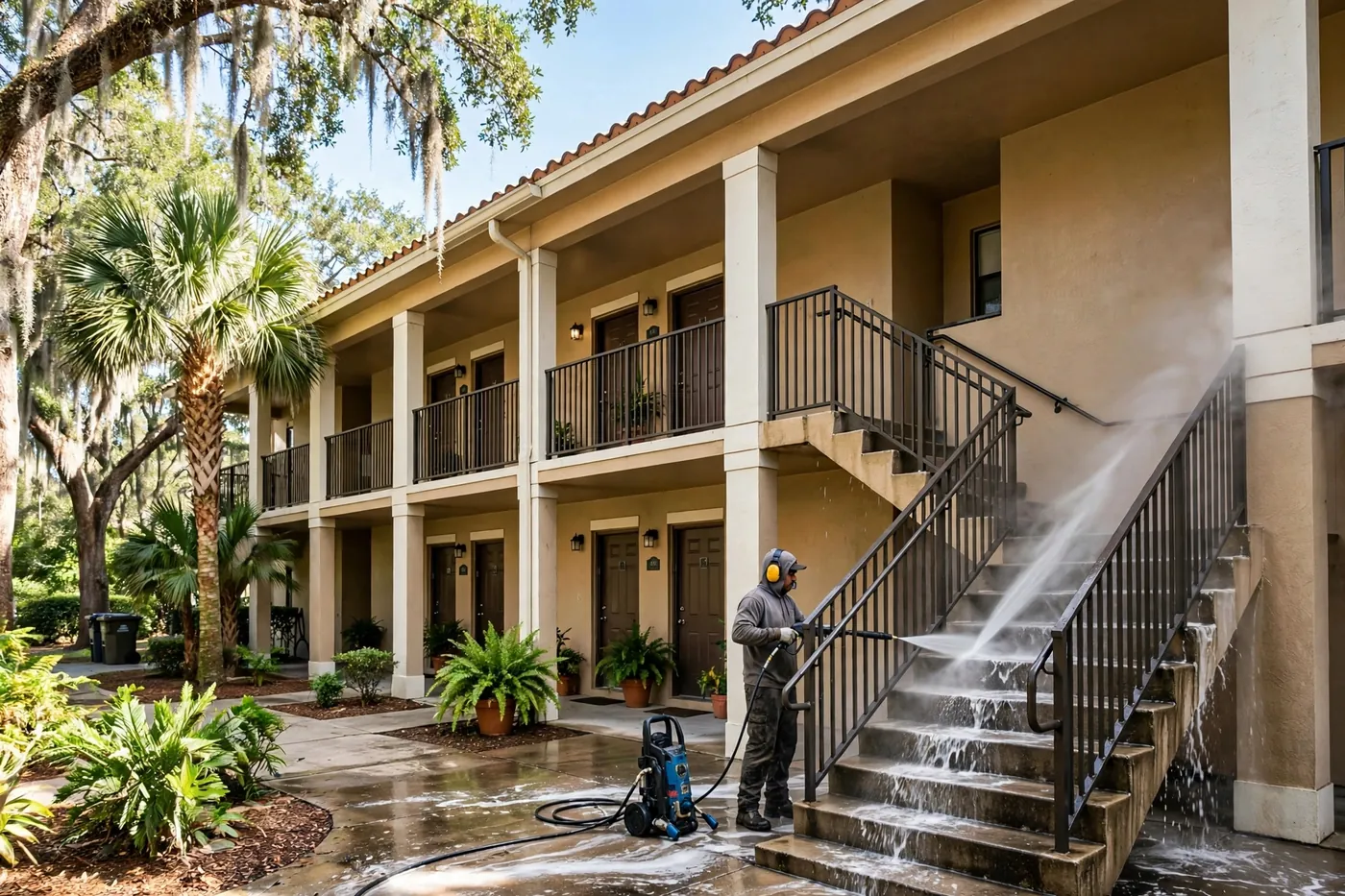
Breezeways, stairwells and turnovers: exterior programs built for property managers.
BEFOREAFTER
Drag to compareJacksonville is a garden-style apartment town — sprawling complexes across the Southside, Baymeadows, Arlington, Orange Park, and the Town Center corridor, where residents live their comings and goings in open-air breezeways. Those breezeways are the building's hallways, and in Jacksonville's climate they age like hallways never do: shaded concrete grows algae within months, oak pollen films every horizontal surface each spring, and humidity keeps it all damp enough for mildew to thrive year-round.
Prospective residents tour breezeways. Current residents judge management by them daily — the walk from the parking lot to the front door is the property's handshake, repeated twice a day. Stained, slick, gum-speckled breezeways quietly tell residents that maintenance is reactive, and that perception shows up in renewals. The properties with the strongest occupancy in this market almost always have the cleanest common areas; it is not a coincidence.
There is also a safety dimension that keeps managers up at night. Algae-slick breezeway floors and stairwells are slip hazards, and in Florida's litigious environment, a fall on a visibly neglected walkway is a liability conversation nobody wants. Regular cleaning is risk management disguised as curb appeal.
A proper breezeway service is more than a quick rinse. Floors get surface-cleaner treatment for an even, streak-free finish — the rotary surface cleaner is what separates professional results from wand-striped concrete. Walls and columns are soft washed to remove mildew and cobwebs without damaging paint. Railings, which collect hand oils and grime, are wiped and rinsed. Stairwells — treads, risers, and landings — get detailed attention because they combine heavy traffic with the worst drainage.
We work around the realities of occupied buildings: parked cars, patio furniture, grills, and the occasional resident who needs to get through. Our crews announce themselves, keep hoses routed tight to walls, and never block a breezeway entirely — one side stays passable while the other is cleaned. Light fixtures get a rinse but not a blast; we are careful around electrical, and anything that looks compromised gets flagged to maintenance rather than forced.
An honest scope note: we clean the common areas — breezeways, stairs, landings, and building-adjacent walkways. Private patios and balconies are typically handled at turnover or by separate arrangement, since they contain residents' belongings. We will scope it either way; just tell us where the line is.
Interior make-readies get all the attention, but the exterior half of a turnover is what the new resident sees first. The vacated unit's patio or balcony — often the most neglected square footage in the apartment — needs a full reset: built-up grime, grill grease, planter stains, and whatever the last tenant left behind. The entry walk and the breezeway section in front of the unit should look as fresh as the repainted interior.
Timing is everything in turnovers. We coordinate with your make-ready schedule, typically cleaning exteriors after interior work is done so the unit shows perfectly. For high-turnover seasons — summer, when Jacksonville's leasing peaks — we can hold recurring weekly slots for your portfolio so a turnover clean is a phone call away, not a scheduling project.
The standard we aim for: a new resident walking to their door for the first time should feel the same pride as when they toured the model. That feeling is worth more than the cost of the cleaning, and it is entirely achievable with the exterior included in the make-ready checklist.
Cleaning an occupied complex is choreography. We phase the work building by building, post 48-hour notices at your direction (or work with your notice system), and schedule the noisiest work for mid-morning to mid-afternoon — after the morning rush, before residents return. Early mornings and late evenings near bedroom windows are avoided as a matter of policy.
Water access is rarely an issue: our trucks carry their own supply, so we do not need to tap your spigots or run hoses across parking lots. Runoff is managed to keep it out of landscaping beds and away from parked cars — a real concern in Jacksonville, where reclaimed irrigation water already spots vehicles and nobody wants wash water adding to it.
Communication is built for property managers: one point of contact, advance scheduling with calendar holds, and photo documentation of every completed building. If a regional manager wants to verify work across three properties without driving them, the photos do it.
The managers who stop thinking about breezeways are the ones on a plan. For most Jacksonville complexes, that means quarterly breezeway and stairwell service, semi-annual building wash, and on-call turnover cleans — a cadence that keeps common areas permanently presentable through pollen season, summer storms, and the holidays. High-traffic properties near the Town Center or the beaches may need breezeways quarterly without exception; shaded, wooded properties in Mandarin or Arlington need the mildew control most.
Contract pricing beats per-visit rates, and — more importantly — it puts your properties on our route calendar instead of in our request queue. Hurricane season is the reason this matters: after a named storm, every property manager in Duval County calls at once, and route clients get priority. Professor Pressure Washing is family-owned and has served Jacksonville since 2015; we are built for exactly this kind of ongoing relationship.
Call (904) 938-5900 to walk one property or scope a whole portfolio. We will give you itemized, per-building pricing your owners can approve, and a schedule your on-site teams can actually live with.
We phase the work building by building, post 48-hour notices through your system, and run the noisiest work mid-morning to mid-afternoon — avoiding early mornings and evenings near bedroom windows. One side of each breezeway stays passable while we clean the other, and our trucks carry their own water so we never run hoses across your parking lots.
Floors with an even surface-cleaner finish, soft-washed walls and columns, railings, and full stairwells — treads, risers, and landings. We rinse light fixtures carefully and flag anything compromised to your maintenance team. Private patios and balconies are handled at turnover or by separate arrangement, since they contain residents' belongings.
Yes — quarterly breezeway and stairwell service with semi-annual building washes is the standard cadence, plus on-call turnover cleans. Contract clients get route priority (which matters after hurricane season), consolidated billing, and photo documentation after every visit. Call (904) 938-5900 for itemized per-building pricing.
San Marco's 1920s–40s Mediterranean Revival homes need a gentle touch. Here's how to clean brick, stucco and historic wood without damage.
Read More →Ortega's riverfront estates face salt air, river humidity and dock grime. A complete guide to waterfront exterior cleaning.
Read More →Springfield's century-old homes need soft washing, not brute force. How to restore historic siding safely.
Read More →Call now for a free estimate and same-day service in Jacksonville, FL. Open 24/7.
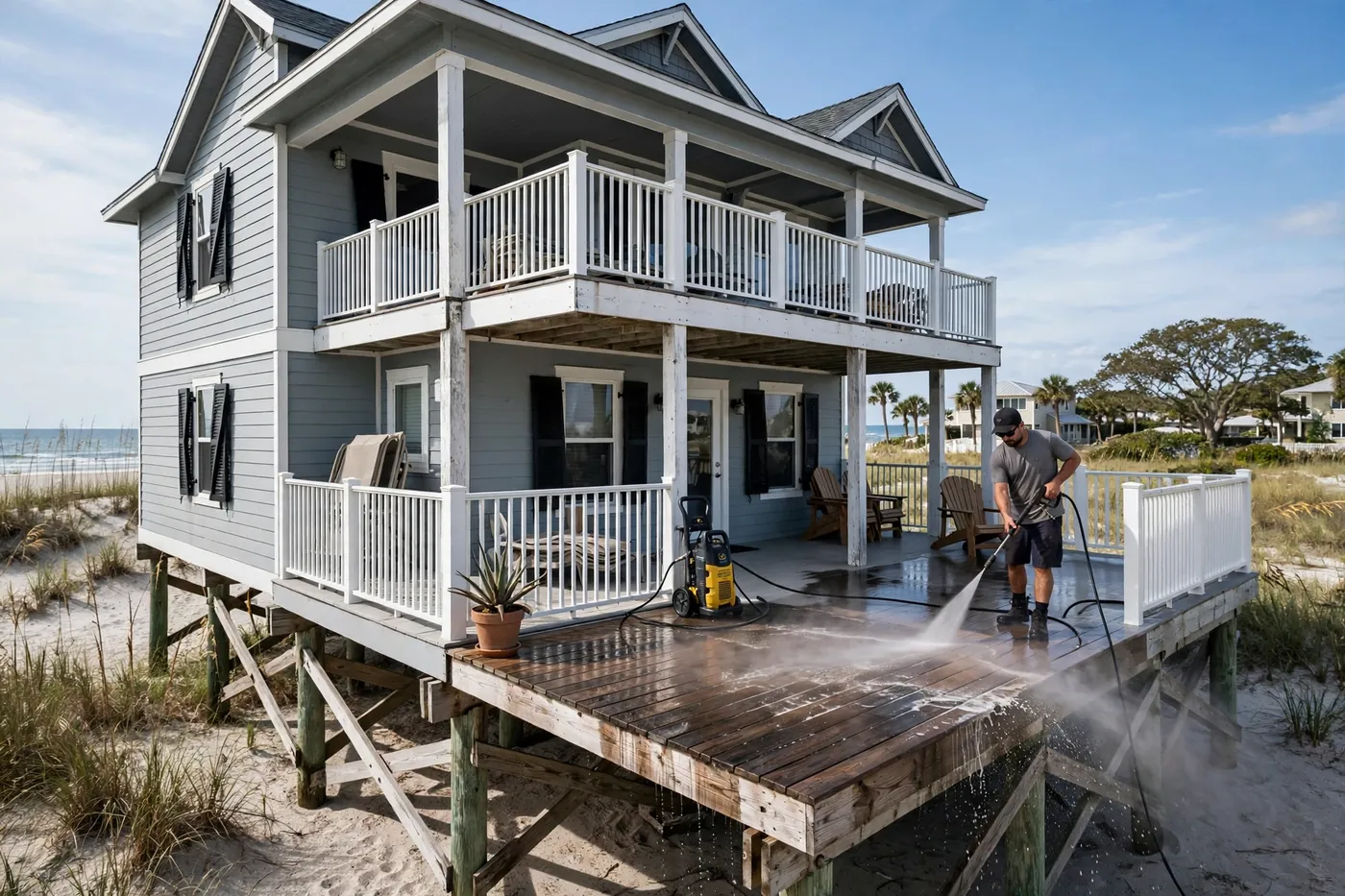
Between-guest exterior resets that protect your reviews and your rates at the beaches.
BEFOREAFTER
Drag to compareScroll any Jacksonville Beach, Neptune Beach, or Atlantic Beach rental listing and count how many lead photos are exteriors: the deck at golden hour, the outdoor shower, the entry with the bikes. Guests book the fantasy of beach living, and they arrive comparing reality to those photos within seconds. Salt film on the siding, sand ground into the deck boards, and green algae on the outdoor shower walls tell a different story — and that story ends up in reviews.
Beach rentals take a beating no inland property matches. Salt air corrodes and films every surface, windblown sand abrades decks and railings, and the humidity that rolls off the ocean keeps everything damp enough for mildew to thrive between guests. A property that looked crisp in April can look tired by August, right in the middle of peak season when rates — and review stakes — are highest.
The hosts who hold Superhost status through summer are not lucky; they are systematic. Exterior turnover cleaning between guests, or at minimum on a tight recurring schedule, keeps the property matching its photos. In a market where a single three-star review mentioning a 'grungy exterior' can cost real bookings, it is some of the cheapest insurance a host can buy.
A turnover reset is not a deep restoration — it is a fast, targeted refresh of everything guests see and touch. The entry: steps, landing, and door surround, where sand and salt accumulate fastest. The deck or patio: sand swept from between boards, algae treated, railings wiped down. The outdoor shower — a Jacksonville Beach signature — which grows pink and green biofilm with shocking speed and is photographed by guests constantly.
Driveways and walkways get a pass for sand drift and oil spots from guest cars. Trash and recycling areas get rinsed — nothing kills a five-star arrival like the smell of last week's fish scraps in 95-degree heat. And the grill area, if you provide one, gets degreased; grease splatter on pavers is one of those details guests notice without knowing why the place feels off.
We work from your turnover checklist or build one with you on the first visit. Most resets take a couple of hours for a typical beach house, and we schedule in the window between checkout and check-in — often the same day. Tell us the lockbox code and the deadline; we handle the rest.
After hundreds of beach rental turnovers, the pattern is clear. Guests notice the outdoor shower first — it is intimate, it is used daily, and biofilm there feels personal in a way a dusty baseboard never does. Second is the deck: bare feet find every rough, sandy, algae-slick board, and deck photos are the backbone of beach listings. Third is the entry sequence — the walk from the car to the door sets the emotional tone for the whole stay.
Sand is the silent killer. It hides in deck board gaps, grinds into painted steps, and migrates inside no matter how many outdoor rinses you provide. A professional wash between guests resets the sand clock in a way a leaf blower cannot — blowers just relocate it. Water extraction actually removes it.
Here is the honest part: exterior cleaning cannot fix a worn-out deck or peeling paint, and if your listing photos show a property in better shape than reality, no wash bridges that gap. But for the vast majority of beach rentals — structurally sound, just salt-and-sand tired — a turnover reset makes the real property match its photos, which is all the reviews ask for.
One-off turnovers help, but the economics favor a schedule. During peak season (March through August at the beaches), weekly or bi-weekly exterior touch-ups keep the property permanently guest-ready, and the per-visit cost drops on a route. Shoulder season can stretch to monthly. Property managers running a dozen doors from Neptune Beach to Ponte Vedra typically put the whole portfolio on one cadence with consolidated billing.
The operational details matter: we need gate codes, outdoor water access (we carry our own if needed), and your turnover calendar. Many managers simply add us to their cleaner coordination — we arrive after checkout, finish before the interior cleaner's final walkthrough, and send photos confirming the exterior is done. No host involvement required after setup.
Storms deserve a mention. A summer squall can undo a month of exterior care in an afternoon, redepositing sand and debris across everything. Managers on a plan get priority re-scheduling after named storms — because the guests arriving Friday do not care that Tuesday had a tropical storm warning.
Professor Pressure Washing is family-owned and has served Jacksonville since 2015, and beach rentals have been a core part of our work for years. We understand turnover windows, lockbox logistics, and the particular misery of salt-caked outdoor showers. Our crews are fast, self-contained, and photo-documented — you will see the result without driving to the beach.
If you are a host watching reviews slip or a manager standardizing a portfolio, call (904) 938-5900. We will walk the property, build a turnover checklist with you, and put the exterior on a schedule that protects your ratings through peak season and beyond.
Most beach house exteriors take a couple of hours, and we routinely work same-day turnover windows between checkout and check-in. Give us the lockbox code and the deadline when you book — morning checkouts cleaned by afternoon check-ins are our normal operating mode during peak season. For larger properties or first-time deep cleans, we will tell you honestly if we need a wider window.
The outdoor shower, the deck under bare feet, and the entry walk — in that order. Those three areas dominate both listing photos and reviews, so they anchor every turnover reset we do. Sand in deck boards and biofilm in the shower are the two fastest-appearing problems at the beaches, which is why recurring schedules beat one-off cleanings.
Yes — weekly or bi-weekly in peak season, monthly in shoulder season, with per-visit pricing that drops on a route. Property managers can put a whole portfolio on one cadence with consolidated billing and photo confirmation after every visit. Call (904) 938-5900 and we will build the schedule around your turnover calendar.
San Marco's 1920s–40s Mediterranean Revival homes need a gentle touch. Here's how to clean brick, stucco and historic wood without damage.
Read More →Ortega's riverfront estates face salt air, river humidity and dock grime. A complete guide to waterfront exterior cleaning.
Read More →Springfield's century-old homes need soft washing, not brute force. How to restore historic siding safely.
Read More →Call now for a free estimate and same-day service in Jacksonville, FL. Open 24/7.