
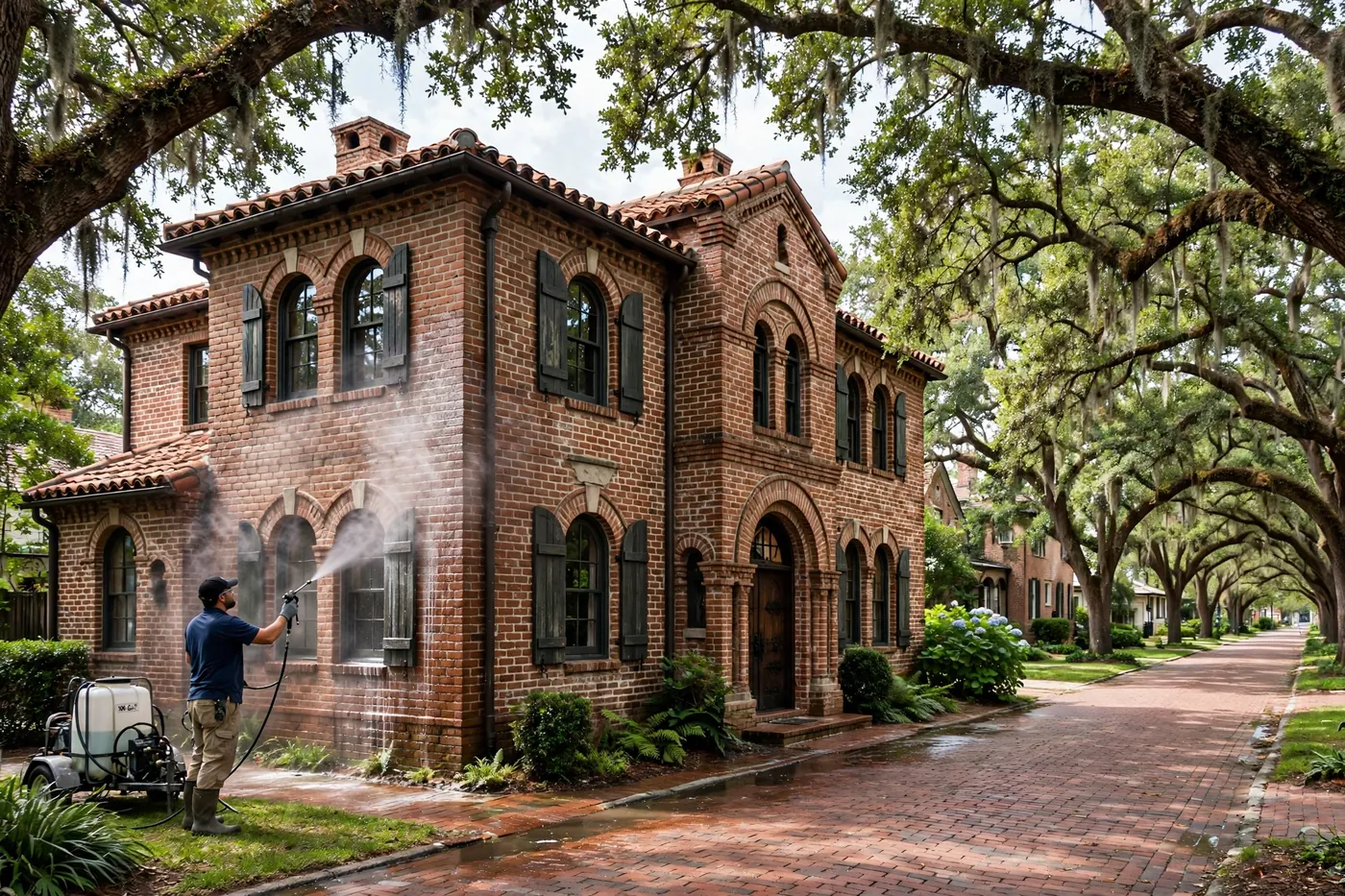
Pressure Washing in San Marco: Brick, Stucco & Historic Homes
San Marco's 1920s–40s Mediterranean Revival homes need a gentle touch. Here's how to clean brick, stucco and historic wood without damage.
Read More →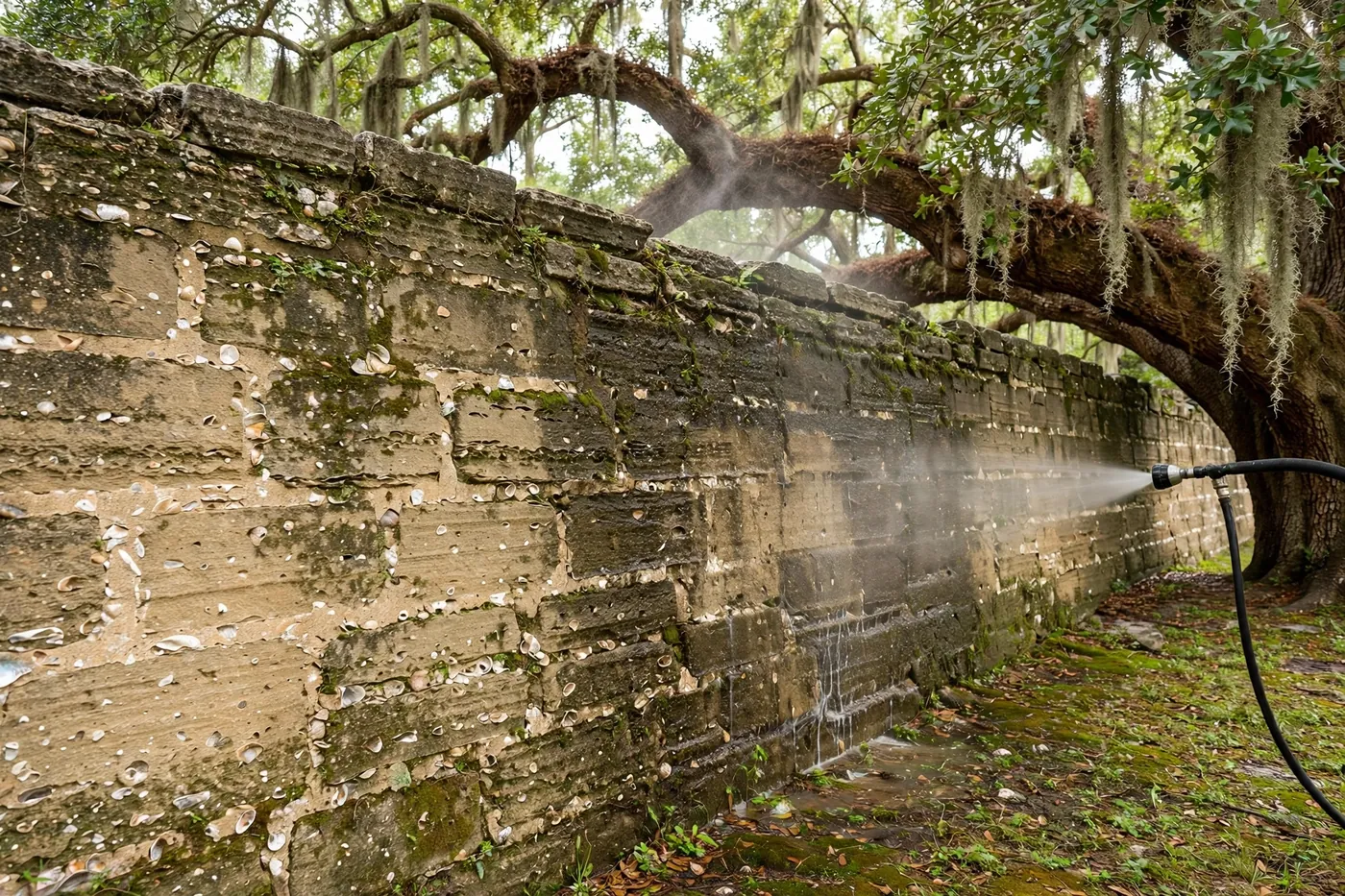
Coquina and tabby crumble under pressure. How Jacksonville's historic masonry must be cleaned.
 BEFOREAFTER
Drag to compare
BEFOREAFTER
Drag to compareBefore there was concrete block, before Portland cement, the First Coast built with what the land provided. Coquina — a soft limestone formed from compressed seashells — was quarried on Anastasia Island and used for everything from St. Augustine's Castillo de San Marcos to garden walls and foundations across the Jacksonville area. Tabby, a concrete made from burnt oyster shells, sand, water, and sometimes whole shells, was the region's original masonry, used in structures dating to the 1700s and 1800s.
You'll still find both materials across Jacksonville: coquina in historic garden walls in Riverside and Avondale, in old foundations in Springfield and San Marco, in decorative features on Mediterranean Revival homes. Tabby survives in some of the area's oldest standing structures and ruins. These aren't just building materials — they're artifacts, irreplaceable pieces of Florida's colonial and territorial history sitting in plain sight.
And they're heartbreakingly fragile by modern masonry standards. Coquina's compressive strength is a fraction of modern concrete's; you can scratch it with a fingernail in places. Tabby varies wildly depending on its mix and age, but historic tabby is often soft, porous, and held together as much by history as by chemistry. Cleaning them requires a completely different mindset from cleaning a modern concrete wall.
Let's be blunt: a pressure washer can destroy coquina in seconds. The shell-based stone is so soft that even moderate pressure — the kind that's perfectly safe on modern concrete — erodes the surface, carves channels, and dislodges the shell fragments that give coquina its structure. We've seen well-meaning homeowners and inexperienced contractors take years off a historic wall's life in a single afternoon. The damage is irreversible; you can't un-erode stone.
Tabby is more variable but equally at risk. Sound, well-maintained tabby can tolerate gentle cleaning, but deteriorated tabby — and much of the historic tabby in our area is deteriorated — crumbles under direct pressure. The lime-based binder in historic tabby is water-soluble to a degree, which means aggressive washing doesn't just erode the surface, it can dissolve the very matrix holding the material together.
The rule for both materials is absolute: soft wash only, never direct high pressure. And 'soft wash' here means the gentlest end of the spectrum — low-pressure application of appropriate cleaning solutions, soft-bristle brushing where needed, and patient rinsing. If a contractor's plan for your coquina wall involves anything over a few hundred PSI, or a zero-degree nozzle anywhere near it, stop the job before it starts.
Proper historic masonry cleaning starts with assessment, not equipment. We examine the wall for the conditions that change everything: spalling (flaking surface), sugaring (granular disintegration), open mortar joints, previous repairs, biological growth type, and salt efflorescence. A wall with sound mortar and light algae gets a very different treatment from a wall with failing joints and deep lichen colonization. Anyone who quotes a historic masonry job without touching the wall first is guessing.
The cleaning itself is deliberately undramatic. We apply a gentle, pH-appropriate cleaning solution — for coquina and tabby, typically a mild biocide for organic growth, never harsh acids unless efflorescence specifically requires it and the material can tolerate it. Dwell time does the work. Soft-bristle brushes agitate stubborn areas by hand. Rinsing is low-pressure and generous, washing everything away without driving water deep into the porous stone.
For efflorescence — the white salt bloom common on historic masonry in Jacksonville's humid, salt-air environment — the approach is different from organic growth. Salts need to be dissolved and flushed, not just killed, and the underlying moisture source addressed where possible. Acid-based efflorescence removers exist, but on coquina and historic tabby they're a last resort requiring expert judgment; the wrong acid on the wrong stone causes more damage than the salts ever did.
The most common damage is also the saddest: erosion from pressure washing, usually done years ago by someone who didn't know better. It shows as a smoothed, rounded loss of surface detail — the crisp shell texture of coquina worn soft, the aggregate of tabby exposed and crumbling. There's no fixing it; the best outcome is stabilizing what's left and preventing further loss. This is why we lead every historic masonry conversation with education.
Second most common: inappropriate chemical damage. Bleach used too strong or left too long can lighten historic masonry unevenly. Muriatic acid — sometimes recommended online for 'cleaning' masonry — can dissolve coquina's calcium carbonate matrix on contact. And well-meaning owners sometimes seal historic masonry with modern waterproof sealers that trap moisture inside, accelerating freeze-thaw and salt damage. Historic masonry needs to breathe; sealing it is often the worst thing you can do.
Avoiding all of this comes down to one principle: hire experience, not equipment. Ask prospective contractors specifically about their historic masonry work — not pressure washing generally, but coquina and tabby specifically. Ask what pressure they'll use (the answer should be in the low hundreds of PSI or 'garden hose'), what chemicals (they should name them and explain why), and whether they've worked on designated historic structures. Vague answers are disqualifying.
Cleaning is an event; preservation is a practice. For coquina and tabby in the Jacksonville climate, the long-term program is straightforward: keep vegetation off the wall (roots and vines pry apart historic masonry, and the shade they cast feeds algae), manage water (gutters, grading, and downspouts that keep runoff from cascading down historic walls), and address mortar joints before they become structural problems — repointing with appropriate lime-based mortar, never modern Portland cement, which is harder than the historic material and causes the stone to fail around it.
Inspection beats intervention. Walk your historic masonry twice a year — spring and fall — looking for new spalling, open joints, efflorescence blooms, and biological growth. Catching a failing mortar joint early means a small repointing job; catching it late means rebuilding a wall section. The same goes for cleaning: light organic growth removed promptly with gentle methods never becomes the deep colonization that requires aggressive treatment.
If you're responsible for a historic coquina or tabby structure — a homeowner in Riverside or Avondale, a church, a historic site — and it needs cleaning, call (904) 938-5900. Professor Pressure Washing has worked on Jacksonville's historic materials since 2015, and we treat every coquina wall and tabby structure as the irreplaceable artifact it is. We'll assess it honestly, clean it gently, and tell you straight what it needs next. Some things are worth doing slowly.
Tabby is a historic concrete made from burnt oyster shells (for lime), sand, water, and sometimes whole shells — the First Coast's original masonry, used in structures dating to the 1700s and 1800s. You'll find it in some of the Jacksonville area's oldest surviving structures and ruins, as well as historic foundations. Like coquina, it's significantly softer and more porous than modern concrete, which is why it needs specialized gentle cleaning rather than standard pressure washing.
Coquina is a soft shell-based limestone with a fraction of modern concrete's strength — you can scratch it with a fingernail in places. Even moderate pressure washer settings erode its surface, carve channels, and dislodge the shell fragments that give it structure, and the damage is irreversible. Historic tabby's lime-based binder can actually dissolve under aggressive washing. Both materials require soft-wash-only methods: gentle cleaning solutions, hand brushing, and low-pressure rinsing.
Proper cleaning starts with hands-on assessment of the wall's condition — spalling, mortar joints, growth type, and salt deposits all change the approach. Then a pH-appropriate gentle cleaning solution is applied at low pressure, given dwell time to work, agitated with soft-bristle brushes where needed, and rinsed gently and thoroughly. Efflorescence (salt bloom) needs dissolving and flushing rather than biocides, and acids are a last resort requiring expert judgment. The whole process prioritizes preservation over speed.
San Marco's 1920s–40s Mediterranean Revival homes need a gentle touch. Here's how to clean brick, stucco and historic wood without damage.
Read More →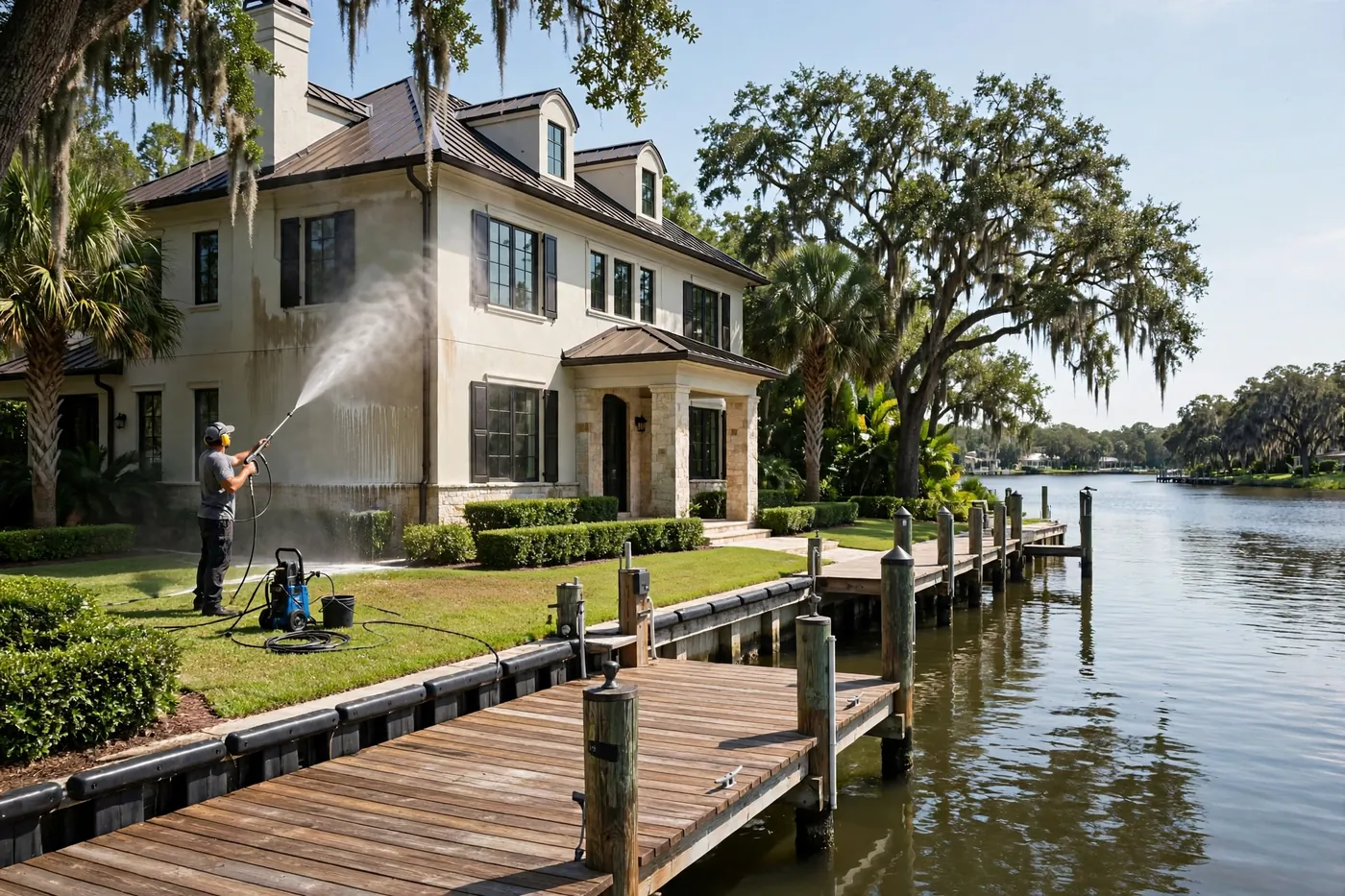
Ortega's riverfront estates face salt air, river humidity and dock grime. A complete guide to waterfront exterior cleaning.
Read More →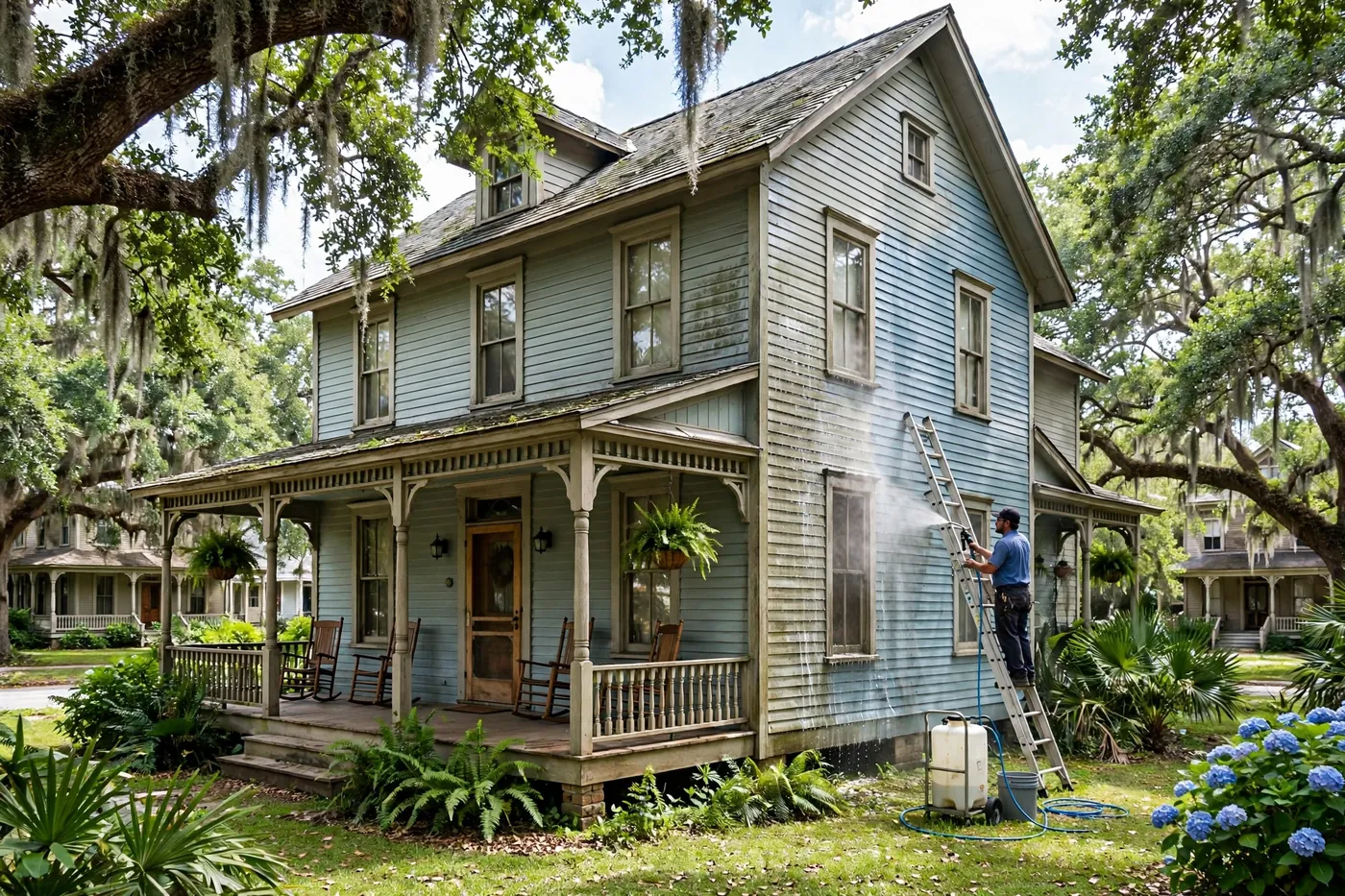
Springfield's century-old homes need soft washing, not brute force. How to restore historic siding safely.
Read More →Call now for a free estimate and same-day service in Jacksonville, FL. Open 24/7.